
Industry Knowledge
3528 vs. 2835 vs. 5050 vs. 3030 LED: What's the Difference?
Compare 3528, 2835, 5050 and 3030 SMD LEDs. Learn their differences, specifications, applications and how to choose the right LED package for your lighting business.
SMD LED Comparison
Choosing the right LED package is an important decision for LED lighting manufacturers, importers, wholesalers, and lighting brands. Different SMD LED packages offer different sizes, power capabilities, thermal performance, and lighting applications. Among the most commonly used types are 3528, 2835, 5050, and 3030 LEDs. Although these numbers may look similar, they represent different package dimensions and designs.
So, what is the difference between 3528, 2835, 5050, and 3030 LEDs? Which type is more suitable for LED bulbs, panel lights, batten lights, floodlights, and streetlights? In this guide, we will compare their structures, specifications, advantages, applications, and purchasing considerations to help B2B buyers make better sourcing decisions.
Key takeaways
The four model numbers describe package dimensions in millimeters, not brightness, wattage, or quality.
2835 is the usual choice for general indoor lighting; 3030 supports higher-power outdoor and industrial fixtures.
5050 is most associated with RGB and multi-color designs; 3528 remains a low-power decorative package.
A larger package does not automatically mean more lumens, better efficacy, or longer life.
1. What Do 3528, 2835, 5050, and 3030 Mean in LED Lighting?
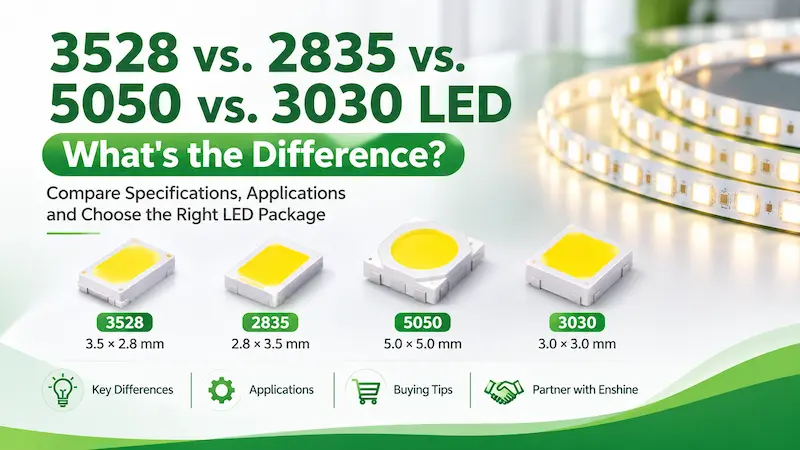
3528, 2835, 5050, and 3030 are numbers used to identify the package dimensions of SMD (Surface Mounted Device) LEDs. The first two digits generally represent the package length, while the last two digits represent its width, measured in millimeters. For example:
3528 = 3.5 × 2.8 mm
2835 = 2.8 × 3.5 mm
5050 = 5.0 × 5.0 mm
3030 = 3.0 × 3.0 mm
These dimensions help identify the physical size of an LED package. However, they do not directly indicate its brightness, wattage, or quality. Two LEDs with the same package size can have different chip designs, electrical characteristics, luminous efficacy, and thermal performance.
2. 3528 vs. 2835 vs. 5050 vs. 3030 LED: Comparison Table
Here is a quick comparison of the four common SMD LED packages.
Specifications | SMD 3528 | SMD 2835 | SMD 5050 | SMD 3030 |
|---|---|---|---|---|
Package size | 3.5 × 2.8 mm | 2.8 × 3.5 mm | 5.0 × 5.0 mm | 3.0 × 3.0 mm |
Typical structure | Single-chip | Single-chip | Multiple dies or emitters | Commonly single-chip |
Common power examples | 0.06W | 0.2W / 0.5W | Varies by design | 0.5W / 1W |
Main advantage | Low cost | Versatility | Multi-color capability | High-power options |
Common applications | Decorative strips | General lighting | RGB strips | Outdoor lighting |
Note: These are representative configurations, not fixed industry standards. Actual wattage and performance depend on the LED manufacturer's design, chip technology, operating current, and thermal management.
3. Detailed Comparison of Four SMD LED Types
3.1 SMD 3528 LED: A Traditional Low-Power LED Package
SMD 3528 is one of the earlier and widely recognized SMD LED package types. With a package size of 3.5 × 2.8 mm, it is commonly used in low-power lighting applications.
Key characteristics:
Package size: 3.5 × 2.8 mm
Typical power: 0.06W–0.08W
Commonly uses a single LED chip
Compact design and relatively low cost
Suitable for low-power applications
Common applications:
Traditional LED strip lights
Decorative lighting
Indicator lights
Low-power accent lighting
Although 3528 LEDs are still used in decorative lighting, they are less common in modern general-purpose LED lighting products, where 2835 packages offer more flexible performance options.
3.2 SMD 2835 LED: A Popular Choice for General Lighting
SMD 2835 is one of the most widely used LED packages in modern general lighting applications. Its compact 2.8 × 3.5 mm design allows manufacturers to arrange LEDs at relatively high density on a PCB. Compared with traditional 3528 packages, many 2835 designs feature improved thermal management and are available in a wider range of power configurations.
Key characteristics:
Package size: 2.8 × 3.5 mm
Common power options: 0.2W, 0.5W and other configurations
Commonly uses a single LED chip
Compact package with good thermal design potential
Suitable for high-density LED arrangements
Offers a good balance between cost and performance
Common applications:
LED Tube Lights
LED Strip Lights
Why do lighting manufacturers choose 2835 LEDs? For manufacturers producing high-volume commercial lighting products, cost efficiency and consistent performance are important. 2835 LEDs offer flexibility in PCB layout, power selection, and lighting design. They are therefore a popular option for many indoor lighting products.
3.3 SMD 5050 LED: Designed for Multi-Color Lighting Applications
SMD 5050 features a larger 5.0 × 5.0 mm package. One of its best-known configurations is the RGB design, which integrates red, green, and blue LED dies into a single package. By controlling the different color channels, RGB 5050 LEDs can produce various colors and lighting effects.
Key characteristics:
Package size: 5.0 × 5.0 mm
Can integrate multiple LED dies or emitters
Commonly available in RGB configurations
Suitable for color-changing lighting systems
Larger package area than 2835 and 3030
Common applications:
RGB LED Strip Lights
Decorative Lighting
Smart Ambient Lighting
Color-Changing LED Products
Architectural Accent Lighting
Is 5050 brighter than 2835? Not necessarily. Although 5050 has a larger package size, actual brightness depends on the LED chip, number of dies, operating current, and optical design. A high-efficiency 2835 LED can produce more lumens per watt than some 5050 configurations. Therefore, B2B buyers should compare actual luminous flux and efficacy rather than package dimensions alone.
3.4 SMD 3030 LED: A Common Choice for Higher-Power Lighting
SMD 3030 is a widely used LED package in commercial and outdoor lighting applications. With a 3.0 × 3.0 mm package, it can be designed for relatively high operating currents and higher power configurations. Some 3030 products use ceramic or specially engineered package materials to improve thermal performance.
Key characteristics:
Package size: 3.0 × 3.0 mm
Common power examples: 0.5W and 1W
Commonly uses a single LED chip
Available in high-power configurations
Thermal performance depends on package construction and PCB design
Common applications:
LED Floodlights
Outdoor Commercial Lighting
Industrial Lighting
Why is 3030 popular in outdoor lighting? Outdoor lighting products often operate at relatively high power and require reliable thermal management. 3030 LED packages offer manufacturers suitable options for designing streetlights, floodlights, and industrial lighting systems. However, the final performance also depends on the PCB material, heat sink, operating current, driver, and overall thermal design.
4. Which SMD LED Is Best for Different Lighting Applications?
There is no single best LED package for every lighting product. The right choice depends on the required power, light output, efficiency, thermal conditions, and target product cost. Here is a practical reference for lighting manufacturers and buyers.
LED Lighting Product | Common LED Package Choices | Main Considerations |
|---|---|---|
LED Bulb | 2835 | Efficiency, cost, thermal management |
LED Panel Light | 2835 | Uniformity, efficacy, CRI |
2835 | Light output, cost, reliability | |
LED Downlight | 2835 / 3030 | Optical design, power, heat dissipation |
LED Floodlight | 3030 | Power, luminous flux, thermal performance |
3030 | Efficacy, heat management, reliability | |
RGB LED Strip | 5050 | Color mixing and control |
Decorative LED Strip | 3528 / 2835 | Brightness, density, cost |
For B2B buyers, it is important to understand that the LED package is only one part of the complete lighting system. The driver, PCB, optical components, and heat dissipation structure also affect the final product performance.
5. What Should B2B Buyers Check When Purchasing SMD LEDs?
When sourcing LED lighting products, buyers should not evaluate LED quality based only on package type. Even LEDs with the same package size can have significantly different performance levels. Here are seven important specifications to check.
1. Rated Power (W)
Rated power indicates the electrical power consumption of an LED under specified operating conditions. Buyers should confirm the recommended operating current and voltage rather than relying on package size to estimate power.
2. Luminous Flux (lm)
Luminous flux measures the total amount of visible light produced by an LED. A higher lumen output generally means more light, provided the measurement conditions are comparable.
3. Luminous Efficacy (lm/W)
Luminous efficacy measures how efficiently an LED converts electrical power into visible light. For example:
LED A: 0.2W, 120 lm/W
LED B: 0.2W, 180 lm/W
Under comparable test conditions, LED B produces more light for the same electrical power. For commercial lighting manufacturers, higher efficacy can help improve the energy performance of the final product.
4. Color Rendering Index (CRI / Ra)
CRI indicates how accurately a light source reveals the colors of objects compared with a reference light source. Common options include:
CRI 70: Basic general lighting
CRI 80: Common commercial and residential lighting
CRI 90: Improved color rendering
CRI 95: High color fidelity applications
The appropriate CRI depends on the target market and lighting application.
5. Correlated Color Temperature (CCT)
CCT describes the appearance of white light. Common options include:
3000K: Warm White
4000K: Neutral White
5000K: Cool White
6500K: Daylight
Buyers should confirm whether the LED supplier can provide consistent color temperatures across production batches.
6. Thermal Resistance and Heat Dissipation
LED operating temperature has a significant influence on long-term reliability and lumen maintenance. Buyers should consider:
LED package thermal resistance
PCB material and thermal design
Heat sink structure
Operating current
Junction temperature under actual working conditions
A high-power LED package does not automatically guarantee better thermal performance.
7. Lumen Maintenance and Reliability
Lumen maintenance describes how well an LED maintains its light output over time. For commercial and industrial lighting, buyers should request relevant reliability data and test reports. They should also evaluate the complete fixture's aging performance rather than relying only on individual LED specifications.
6. Does a Larger LED Package Mean Better Performance?
This is a common misunderstanding among LED lighting buyers. The answer is no. A larger LED package does not automatically mean:
Higher brightness
Higher luminous efficacy
Better quality
Longer lifespan
Better heat dissipation
For example, a 5050 package is physically larger than a 2835 package, but this does not mean every 5050 LED produces more lumens. Similarly, a 3030 LED may support higher-power configurations, but its actual performance depends on chip technology, package materials, current, and thermal conditions.
Professional buyers should compare actual technical specifications instead of choosing LEDs based only on package dimensions.
7. How to Choose the Right LED Package for Your Lighting Business
For importers, wholesalers, and lighting brands, choosing the right LED package is not just a technical decision. It also affects product positioning, manufacturing costs, and market competitiveness. Here are three practical recommendations:
For cost-effective general lighting
2835 is a popular choice for LED bulbs, panel lights, batten lights, and downlights. It offers flexible configurations for different product requirements.
For high-power outdoor lighting
3030 is worth considering for streetlights, floodlights, and high bay lights, especially when the product requires higher power and appropriate thermal management.
For decorative and color-changing lighting
5050 is a common option for RGB applications, while 3528 remains suitable for certain low-power decorative lighting products.
Before placing a bulk order, buyers should confirm the complete technical specifications, sample performance, production consistency, and applicable certifications.
8. Work with an Experienced LED Lighting Manufacturer
Selecting the right LED package is only one step in producing reliable LED lighting products. A professional LED lighting manufacturer should also have the capabilities to control the complete production process, including LED component selection, driver assembly, PCB design, thermal management, product assembly, and quality inspection.
At Enshine Lighting, we specialize in OEM and ODM LED lighting solutions for importers, wholesalers, distributors, and lighting brands. With over 20 years of manufacturing experience, our product range includes:
LED Bulb Lights
LED Batten Lights
LED Downlights
LED Floodlights
Smart and Solar Lighting Products
Our manufacturing capabilities include in-house plastic injection molding, aluminum stamping, die casting, driver assembly, and SMT production. We also implement quality control procedures covering incoming material inspection, driver inspection, production-line quality checks, and product aging tests.
Whether you are developing a new LED lighting range or sourcing products for your existing brand, our team can support your OEM and ODM requirements.
Looking for a reliable LED lighting manufacturer in China?
Visit www.enshinelighting.com to explore our product range and contact our team for your next lighting project.
Frequently Asked Questions (FAQs)
Q1: What is the difference between 3528 and 2835 LED?
3528 and 2835 have different package dimensions and designs. 3528 measures 3.5 × 2.8 mm, while 2835 measures 2.8 × 3.5 mm. Modern 2835 LEDs are widely used in general lighting because of their flexible power configurations and thermal design.
Q2: Is 2835 LED better than 5050 LED?
Neither is universally better. 2835 is commonly used in general lighting applications, while 5050 is popular for RGB and multi-color lighting. The best choice depends on the application and required performance.
Q3: Is 3030 LED brighter than 2835 LED?
Not necessarily. Some 3030 LEDs support higher power and luminous output per package, but actual brightness depends on chip design, operating current, and electrical specifications.
Q4: Which LED package is best for street lights?
3030 is a common choice for LED streetlights because it is available in higher-power configurations. However, the complete optical, electrical, and thermal design determines the final performance.
Q5: What does SMD mean in LED lighting?
SMD stands for Surface Mounted Device. SMD LEDs are electronic components mounted directly onto a printed circuit board (PCB). They are widely used in modern LED lighting products because of their compact size and flexible manufacturing options.
Q6: Does LED package size determine LED lifespan?
No. LED lifespan depends on several factors, including chip quality, junction temperature, operating current, package materials, driver reliability, and the thermal design of the complete fixture.
Q7: What specifications should I request from an LED chip supplier?
Important specifications include rated power, forward voltage, forward current, luminous flux, luminous efficacy, CRI, CCT, thermal resistance, and lumen maintenance data. Buyers should also request relevant datasheets and test reports.