
Industry Knowledge
How to Choose the Right LED High Bay for 20–40 ft Ceilings
Learn how to choose LED high bays for 20–40 ft ceilings. Compare wattage, lumens, beam angle, spacing and fixture types for warehouses and industrial applications.
How to Choose the Right LED High Bay for 20–40 ft Ceilings
Choosing the right LED high bay for a 20–40 ft ceiling requires more than choosing a wattage. Mounting height, required light level, lumen output, beam angle, fixture spacing and the type of application all affect the final lighting result.
For a warehouse, factory, workshop or distribution center, the same 200W high bay may work well in one project but be unsuitable in another.
For distributors, wholesalers, electrical contractors and project buyers, there is another consideration: product consistency. A high bay lighting supplier needs to provide reliable specifications, stable bulk production, suitable drivers, technical support and OEM or ODM options when required.
This guide explains how to choose an LED high bay for 20–40 ft ceilings, including how to compare 100W, 150W and 200W options, how beam angle affects coverage, and what B2B buyers should check before placing a bulk order.
Quick Guide: LED High Bay for 20–40 ft Ceilings
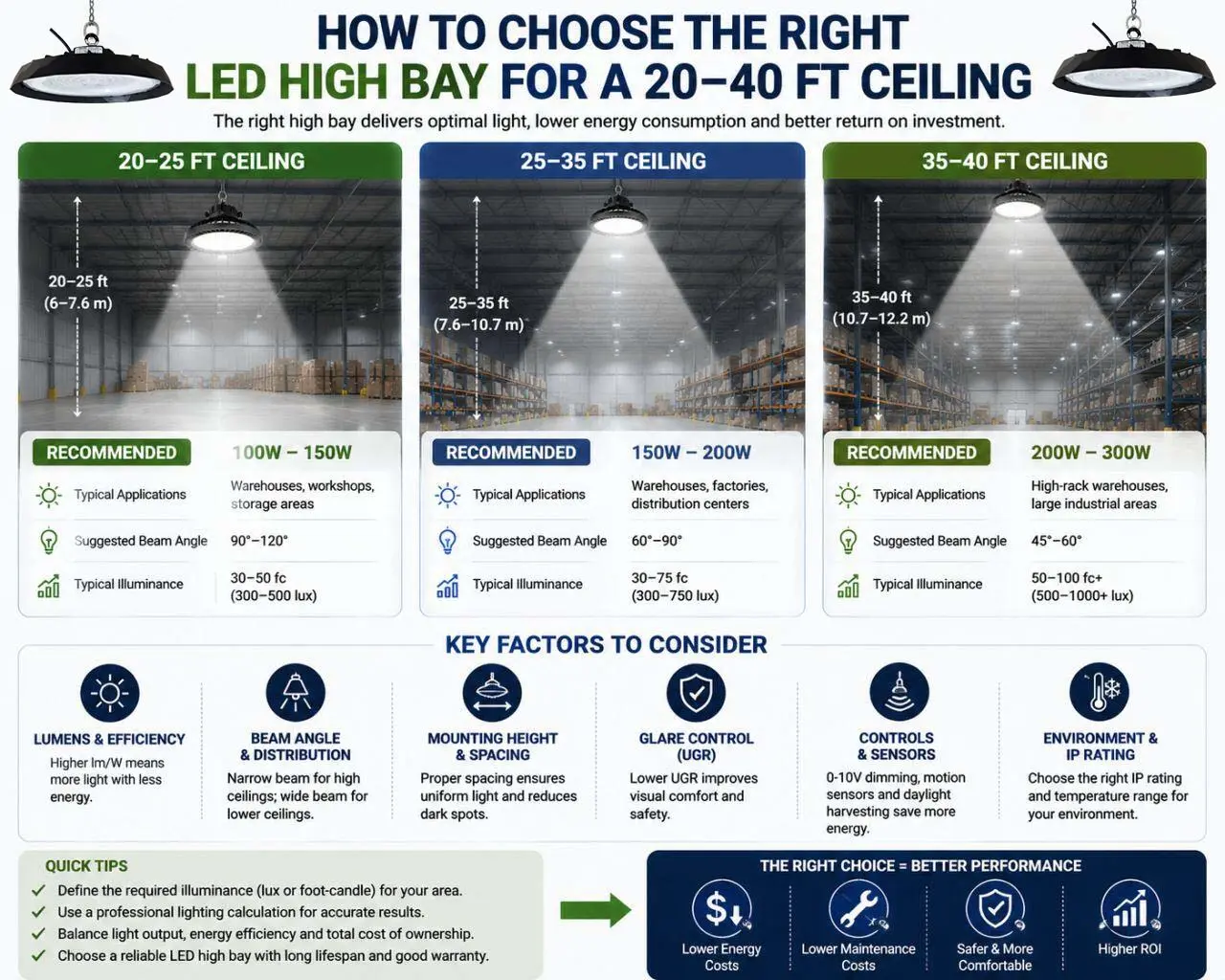
As a starting point, the following options can be considered for different mounting heights:
Mounting Height | Starting Option | Efficacy | Calculated Lumens | Beam Angle |
|---|---|---|---|---|
20–25 ft | 100W / 150W | 120 / 150 lm/W | 12,000 / 22,500 lm | 90° |
25–30 ft | 150W | 150 lm/W | 22,500 lm | 90° |
30–35 ft | 200W | 150 lm/W | 30,000 lm | 90° |
35–40 ft | 200W / project-specific | 150 lm/W | 30,000 lm | 90° |
These are starting options, not universal wattage requirements. The final LED high bay should be selected according to the actual mounting height, target illuminance, fixture spacing, application and photometric data.
Note: Calculated lumen output is based on rated wattage × luminous efficacy. Actual fixture lumen output should be confirmed through the manufacturer's test report or photometric data.
What Should You Consider When Choosing an LED High Bay?
Before choosing an LED high bay, check several specifications together instead of focusing on wattage alone.
The main factors are:
Mounting height
Required illuminance
Lumen output
Wattage
Beam angle
Fixture spacing
Application
Operating environment
CRI
CCT
IP rating
Driver quality
Warranty
Certifications
Photometric performance
For a B2B lighting project, the goal is not simply to find the highest-output fixture. The goal is to achieve the required lighting level and coverage with a practical number of fixtures and reasonable energy consumption.
Mounting Height
The first question should be:
How high will the LED high bay actually be mounted?
A building with a 30 ft ceiling does not always have fixtures mounted at exactly 30 ft. Racking, suspended structures, production equipment and other building elements can change the actual fixture height.
As the mounting height increases, light has to travel farther to reach the working plane. This affects the required lumen output, beam distribution and fixture spacing.
For this reason, use the actual mounting height when choosing a high bay rather than relying only on the total ceiling height.
Required Light Level
Different applications need different lighting levels.
A general storage warehouse does not necessarily need the same light level as a manufacturing area, inspection station or workshop.
The required lighting level depends on what people are doing in the space and the visibility needed for the work.
For larger projects, a photometric layout is the most reliable way to check whether the selected high bay provides sufficient and uniform illumination.
Lumen Output
Wattage tells you how much electrical power the fixture uses.
Lumens describe the amount of light produced.
This is why two high bay lights with similar wattage should not automatically be assumed to have the same performance.
For the Enshine 100W–200W range:
100W × 120 lm/W = approximately 12,000 lumens
150W × 150 lm/W = approximately 22,500 lumens
200W × 150 lm/W = approximately 30,000 lumens
These are calculated values based on rated efficacy. For a project quotation or technical submission, actual fixture lumen output should be confirmed from the relevant test data.
Wattage
LED high bay wattage should be considered together with lumen output and mounting height.
For many 20–40 ft applications, 100W, 150W and 200W provide useful options across different project conditions.
However, a higher ceiling does not automatically mean that the highest wattage is required.
For example, a 150W high bay with good efficacy and appropriate spacing may be more suitable than a poorly positioned 200W fixture.
Beam Angle
Beam angle controls how light spreads from the fixture.
A narrower beam concentrates light into a smaller area. A wider beam distributes light over a larger area.
The correct beam angle depends on mounting height, fixture spacing and floor layout.
Enshine's confirmed high bay configuration uses a 90° beam angle, providing a practical distribution for many warehouse, factory and industrial applications.
Fixture Spacing
Fixture spacing is closely connected to beam angle and mounting height.
If high bays are installed too far apart, dark areas can appear between fixtures. If they are installed too close together, the project may use more fixtures and more energy than necessary.
For this reason, spacing should be considered as part of the complete lighting layout rather than selected from a fixed spacing rule.
Application and Environment
The same LED high bay may not be appropriate for every building.
Consider whether the project is:
A warehouse
A manufacturing facility
A distribution center
A workshop
A logistics center
A gymnasium
A storage area
Also check dust, moisture, temperature and other environmental conditions before selecting the fixture.
LED High Bay Wattage Guide for 20–40 ft Ceilings
The following sections provide a practical starting point for common mounting heights.
LED High Bay for a 20–25 ft Ceiling
For a 20–25 ft mounting height, both 100W and 150W LED high bays can be considered.
A 100W model at 120 lm/W provides approximately 12,000 calculated lumens.
A 150W model at 150 lm/W provides approximately 22,500 calculated lumens.
A 100W fixture may be suitable where the required light level is moderate and fixture spacing is relatively close. A 150W option may be more appropriate where higher illuminance or greater coverage is required.
The final selection should be based on the application and lighting layout.
LED High Bay for a 25–30 ft Ceiling
For a 25–30 ft mounting height, 150W is a practical starting option for many warehouse and industrial applications.
The Enshine 150W configuration provides 150 lm/W, giving approximately 22,500 calculated lumens.
At this height, fixture spacing becomes increasingly important. The 90° beam angle should be evaluated together with the mounting position and floor layout.
Featured Snippet Answer:
For a 30 ft ceiling, a 150W LED high bay can be a practical starting option for many warehouse and industrial applications. At 150 lm/W, a 150W fixture provides approximately 22,500 calculated lumens. Final selection should be based on mounting height, required illuminance, fixture spacing and photometric data.
LED High Bay for a 30–35 ft Ceiling
For 30–35 ft installations, a 200W LED high bay can be considered where higher light output is required.
The Enshine 200W configuration is rated at 150 lm/W, providing approximately 30,000 calculated lumens.
However, 200W should not be selected simply because the ceiling is higher.
Room dimensions, rack height, fixture spacing and target illuminance can all affect the final result.
For larger industrial projects, a photometric layout should be reviewed before the bulk order is confirmed.
LED High Bay for a 35–40 ft Ceiling
A 35–40 ft installation requires more careful planning.
A 200W LED high bay with approximately 30,000 calculated lumens can be considered as a starting option for suitable applications.
However, there is no universal rule that says every 40 ft ceiling requires a 200W fixture.
At this height, mounting position, beam angle, fixture spacing, required illuminance and application have a greater impact on the final lighting result.
Featured Snippet Answer:
For a 40 ft ceiling, a 200W LED high bay with approximately 30,000 calculated lumens can be considered as a starting option. The final wattage should be verified according to actual mounting height, target illuminance, fixture spacing, beam angle and photometric data.
How Many Lumens Do You Need for a 20–40 ft Ceiling?
There is no single lumen requirement based only on ceiling height.
The required output depends on:
Floor area
Mounting height
Required illuminance
Fixture spacing
Beam angle
Surface reflectance
Rack height
Application
Existing lighting
For product comparison, the Enshine range provides:
Model | Wattage | Efficacy | Calculated Lumens |
|---|---|---|---|
Enshine High Bay | 100W | 120 lm/W | 12,000 lm |
Enshine High Bay | 150W | 150 lm/W | 22,500 lm |
Enshine High Bay | 200W | 150 lm/W | 30,000 lm |
This gives B2B buyers a clear starting point when comparing different power options.
However, lumen output should not be confused with illuminance.
Lumens describe the light produced by the fixture, while illuminance describes the light reaching a surface.
For this reason, a 30,000-lumen high bay does not automatically provide the same lighting result in every 30 ft warehouse.
How Far Apart Should LED High Bay Lights Be?
There is no universal spacing distance for all LED high bay installations.
Spacing depends on:
Mounting height
Fixture lumen output
Beam angle
Required illuminance
Fixture position
Room dimensions
Application
For example, two 200W high bays installed too far apart may create dark areas between fixtures.
Installing too many fixtures, on the other hand, can increase the initial project cost and energy consumption.
For larger warehouses and industrial facilities, the better approach is to create a lighting layout based on the actual building dimensions.
A professional LED high bay manufacturer or lighting engineer can then evaluate fixture quantity, spacing and uniformity before the bulk order is confirmed.
What Specifications Should You Check Before Buying an LED High Bay?
A professional B2B buyer should review the complete specification rather than comparing unit price alone.
Luminous Efficacy
Luminous efficacy is expressed in lumens per watt.
Enshine's confirmed high bay configurations are:
100W — 120 lm/W
150W — 150 lm/W
200W — 150 lm/W
When comparing suppliers, check whether the stated efficacy refers to the LED chips or the complete fixture.
For B2B purchasing, fixture-level performance is more useful.
CRI
The confirmed CRI for this high bay range is Ra 80.
CRI indicates how accurately colors are rendered compared with a reference light source.
For general warehouses, factories and industrial applications, CRI 80 is a practical specification.
CCT
The confirmed configuration uses 6500K.
The appropriate color temperature depends on the application and target market.
For distributors serving different markets, available CCT options may also be an important product-development consideration.
IP Rating
The confirmed high bay configuration is rated IP65.
IP65 protection makes the fixture suitable for many warehouse, factory and workshop environments where protection against dust and water jets is required.
The actual environmental conditions should still be checked before selecting the fixture.
Driver Quality
The Enshine high bay configuration uses a Philips driver.
The driver is an important component affecting electrical performance and long-term product reliability.
For B2B buyers, the driver specification should be included in the technical comparison between suppliers.
Warranty
The confirmed warranty for this product range is 5 years.
For distributors and project buyers, warranty terms should be reviewed together with product specifications, production quality and after-sales support.
Certifications
Certification requirements vary by destination market and project.
Before placing a bulk order, confirm which certifications and testing documents are required for the customer's country and application.
Why Buy LED High Bays Directly from a B2B Manufacturer?
For distributors, wholesalers, electrical contractors and project buyers, buying directly from an LED lighting manufacturer can provide advantages beyond the unit price.
A B2B manufacturer can support the complete process from product development to bulk production.
Consistent Product Quality
For a bulk order, consistency is critical.
A customer may purchase thousands of units for one project and require the same specifications for future replenishment.
Stable control of components, assembly and testing helps maintain product consistency between batches.
OEM and ODM Support
A B2B LED lighting manufacturer may be able to support:
Private labeling
Customized packaging
Product specifications
Product development
CCT options
Wattage options
Driver options
Project-specific requirements
This can be particularly useful for lighting distributors and brands building their own product ranges.
Bulk Production
For B2B customers, production capacity matters.
The supplier should be able to provide stable production for repeat orders rather than only one small shipment.
A manufacturer's production system, quality control process and component sourcing can directly affect delivery consistency.
Technical Support
High bay projects often require more than a product datasheet.
Depending on the project, buyers may need:
Product specifications
Photometric data
Installation information
Sample approval
Packaging details
Certification documents
Lighting layout support
Working directly with an experienced LED high bay manufacturer can make these requirements easier to coordinate.
How to Calculate the Number of LED High Bays You Need
A preliminary estimate can start with:
Number of fixtures ≈ Required total lumens ÷ useful lumens per fixture
However, this is only a basic estimate.
A complete lighting calculation should also consider:
Utilization factor
Maintenance factor
Room dimensions
Surface reflectance
Mounting height
Beam distribution
Fixture spacing
Required uniformity
For a small warehouse, a preliminary lumen calculation may be useful for comparing different products.
For a large industrial facility, a photometric calculation is recommended before confirming the final quantity.
This is particularly important for 30–40 ft mounting heights, where fixture positioning and light distribution have a greater effect on the final result.
Common Mistakes When Choosing LED High Bay Lights
Choosing by Wattage Alone
A 200W fixture is not automatically better than a 150W fixture.
Compare wattage together with lumen output, mounting height, beam angle and required illuminance.
Ignoring Actual Mounting Height
A building may have a 40 ft ceiling while the fixtures are mounted at a lower height.
Use the actual fixture mounting height when planning the lighting.
Ignoring Beam Angle
A high-output fixture with an unsuitable beam distribution can still produce poor coverage.
Beam angle should be evaluated together with fixture spacing.
Installing Too Few Fixtures
Reducing fixture quantity may lower the initial purchase cost, but it can create dark areas and poor uniformity.
Installing Too Many Fixtures
The opposite problem is also possible.
Too many fixtures increase the initial investment and energy consumption.
A lighting layout can help find a better balance.
Skipping Photometric Verification
For larger projects, do not rely only on a wattage table.
Ask the LED high bay supplier or manufacturer to review the project dimensions and available photometric data before confirming the final model and quantity.
Enshine LED High Bay: 100W–200W B2B Lighting Solutions
Enshine provides LED high bay solutions for warehouses, factories, workshops, logistics centers and other high-ceiling applications.
Our current high bay range includes 100W, 150W and 200W configurations.
The confirmed specifications include:
Specification | 100W | 150W | 200W |
|---|---|---|---|
Power | 100W | 150W | 200W |
Efficacy | 120 lm/W | 150 lm/W | 150 lm/W |
Calculated Lumens | 12,000 lm | 22,500 lm | 30,000 lm |
CRI | Ra 80 | Ra 80 | Ra 80 |
Beam Angle | 90° | 90° | 90° |
Input Voltage | 100–277V | 100–277V | 100–277V |
Power Factor | >0.9 | >0.9 | >0.9 |
IP Rating | IP65 | IP65 | IP65 |
CCT | 6500K | 6500K | 6500K |
Driver | Philips | Philips | Philips |
Warranty | 5 years | 5 years | 5 years |
The range gives distributors, wholesalers and project customers several power options within one product family.
For B2B customers, Enshine can also support OEM and ODM cooperation, including private labeling, packaging and project-specific product requirements.
For product details, see the UFO LED high bay and LED high bay with Philips driver.
Need Help Choosing the Right High Bay?
If you are a lighting distributor, wholesaler, electrical contractor or project buyer, send us your:
Ceiling height
Actual mounting height
Floor dimensions
Application
Required quantity
Target market
Certification requirements
Our B2B lighting team can help you compare suitable wattages and provide the product information needed for your project.
Request a High Bay Solution
How to Choose an LED High Bay in 5 Steps
If you need a quick way to evaluate a project, follow these five steps.
Step 1: Check the Actual Mounting Height
Determine where the fixture will actually be installed.
Step 2: Determine the Required Light Level
Identify whether the area is used for storage, production, inspection, logistics or another application.
Step 3: Compare Lumen Output
Use the fixture's rated efficacy and wattage as a starting point:
100W → 12,000 lm
150W → 22,500 lm
200W → 30,000 lm
Step 4: Check Beam Angle
Enshine's confirmed configuration uses a 90° beam angle.
Evaluate it together with the mounting height and fixture spacing.
Step 5: Verify the Lighting Layout
For larger projects, use photometric data to confirm fixture quantity, spacing, illuminance and uniformity.
FAQ
What LED high bay do I need for a 20 ft ceiling?
For a 20 ft ceiling, a 100W or 150W LED high bay can be considered depending on the required illuminance, floor area and fixture spacing. A 100W model provides approximately 12,000 calculated lumens, while a 150W model provides approximately 22,500 calculated lumens.
What LED high bay do I need for a 30 ft ceiling?
For a 30 ft ceiling, a 150W LED high bay can be a practical starting option for many warehouse and industrial applications. The 150W configuration provides 150 lm/W, or approximately 22,500 calculated lumens. Final selection should be verified according to mounting height, required illuminance and fixture spacing.
What LED high bay do I need for a 40 ft ceiling?
For a 40 ft ceiling, a 200W LED high bay with approximately 30,000 calculated lumens can be considered as a starting option. However, the final model should be selected according to actual mounting height, target illuminance, beam angle, fixture spacing and photometric data.
What beam angle is best for LED high bay lights?
A 90° beam angle can be a practical choice for many warehouse and industrial applications because it balances light concentration and coverage. The best beam angle depends on mounting height, fixture spacing, floor layout and required illuminance.
How far apart should LED high bay lights be?
LED high bay spacing depends on mounting height, lumen output, beam angle, required illuminance and room layout. There is no single spacing distance that works for every warehouse. Larger projects should use a lighting layout to check illuminance and uniformity.
Is a UFO high bay better than a linear high bay?
Neither fixture type is universally better. UFO high bays can be suitable for many open warehouse and factory applications, while linear high bays can be useful for long aisles, production lines and rack-based layouts. The best choice depends on the building layout and required light distribution.
What specifications should I check before buying LED high bays?
Check wattage, fixture lumen output, luminous efficacy, CRI, CCT, beam angle, input voltage, power factor, IP rating, driver, warranty, certifications and photometric data. B2B buyers should also check production capacity, product consistency, OEM/ODM capability and packaging requirements.
What should I ask an LED high bay manufacturer before placing a bulk order?
Ask about product specifications, actual fixture performance, driver brand, LED chips, beam angle, IP rating, warranty, certifications, MOQ, production capacity, lead time, packaging, OEM/ODM options and available photometric data. For project orders, provide the manufacturer with the mounting height and building dimensions.
Can an LED high bay manufacturer provide OEM and ODM service?
Yes. A B2B LED lighting manufacturer may support private labeling, customized packaging, product specifications and project-based development. These services are useful for distributors, wholesalers, lighting brands and contractors that need a consistent high bay product range for their market.
Choosing the right LED high bay for a 20–40 ft ceiling is not simply about selecting the highest wattage. The right fixture needs to match the actual mounting height, required light level, lumen output, beam angle, spacing and application.
For distributors, wholesalers and project buyers, the supplier is also part of the decision. A capable B2B LED lighting manufacturer should be able to provide stable product quality, technical information, bulk production and OEM or ODM support.
With 100W, 150W and 200W options, Enshine provides a practical high bay range for different warehouse, factory and industrial applications. For project-specific requirements, send the building dimensions and installation details to our team so the appropriate product and lighting configuration can be evaluated.