
Industry Knowledge
Smart Office Lighting: Choosing the Right LED Panel Lights
Smart Office Lighting: Choosing the Right LED Panel Lights for Modern Workspaces
Office lighting is no longer just about making a room bright.
People spend many hours working under artificial light. Poor lighting can cause glare, uneven illumination and visual discomfort. At the same time, lights are often left on in empty rooms or at full output when daylight is already available.
This is why more offices are looking at smart office lighting.
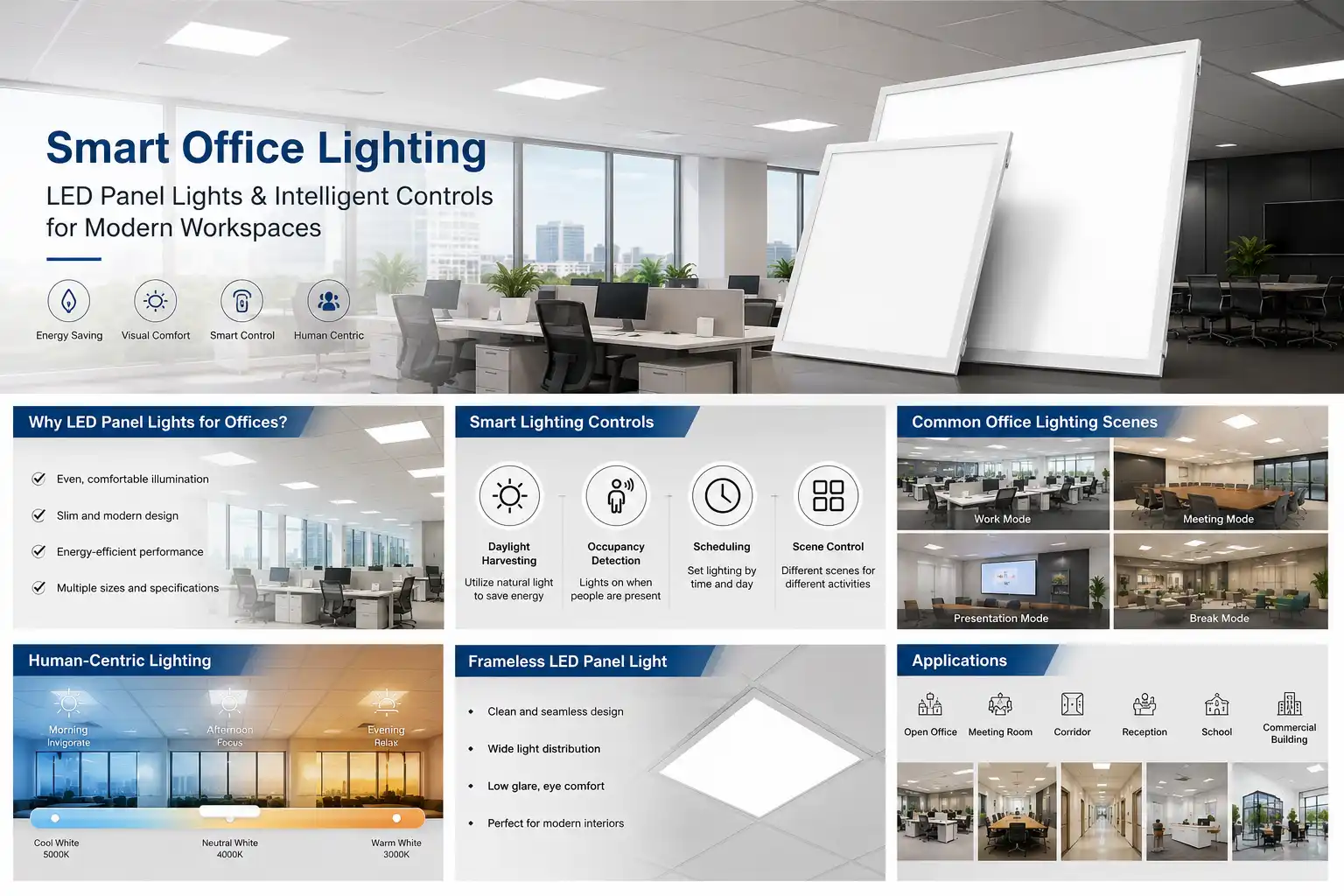
A smart lighting system can adjust the lights based on occupancy, daylight, working hours and different activities. When combined with efficient LED panel lights, it can provide a clean and flexible lighting solution for modern offices.
For lighting distributors, contractors and commercial projects, the key is not to add as much technology as possible. The better approach is to choose the right LED fixtures and use smart controls where they are actually useful.
What Is Smart Office Lighting?
Traditional office lighting usually depends on wall switches. Someone turns the lights on, and they stay on until someone turns them off.
Smart office lighting works differently.
Sensors and controls can adjust the lights automatically. The system can detect whether people are in a room, measure available daylight or follow a preset schedule.
Common smart lighting functions include:
Occupancy and motion detection
Daylight sensing
Dimming
Time scheduling
Lighting scenes
Central lighting control
Integration with building management systems
For example, lights near a window can dim when there is enough natural light. A meeting room can turn off automatically after it has been empty for a set period. Corridors can stay at a low lighting level when nobody is around and increase output when someone enters.
The result is a lighting system that responds to how the building is actually used.
Why Are LED Panel Lights Popular in Offices?
LED panel lights are widely used in offices, schools, commercial buildings and other indoor spaces.
Their main advantage is simple: they provide broad and even illumination from a relatively slim fixture.
A good office panel light should not be judged by wattage alone. Buyers should also look at lumen output, efficacy, glare, CRI, CCT, driver quality and installation method.
Even Illumination
The large luminous surface of an LED panel helps spread light across the room.
This works well for desks and open-plan offices where employees need consistent light across a larger working area.
Clean Appearance
LED panels have a slim and simple design. They fit well into modern suspended ceilings and office interiors.
For projects where the ceiling needs a cleaner appearance, frameless LED panel lights are another option.
Lower Energy Use
LED technology is more efficient than traditional fluorescent lighting in many applications.
The actual energy saving depends on the fixture, operating hours and lighting design. Smart controls can reduce energy use further by dimming or switching off lights when full output is not needed.
Flexible Product Options
Different office projects require different specifications.
A distributor may need several wattages, CCT options or installation methods. A contractor may need a specific driver or dimming function.
A flexible LED panel platform makes it easier to cover these requirements.
Smart Lighting Controls for Office LED Panels
A smart office does not always need a complicated control system.
In many projects, a few practical functions can make a noticeable difference.
The most common options are daylight control, occupancy sensing, scheduling and scene control.
1. Daylight Harvesting
Natural light can provide a large part of the required illumination in offices near windows.
If the LED panels continue working at full power when enough daylight is already available, energy is being used unnecessarily.
A daylight sensor can measure the natural light level. Compatible LED fixtures can then dim or increase their output.
For example:
More daylight → lower LED output
Less daylight → higher LED output
This is often called daylight harvesting or constant-light control.
It is particularly useful in offices with large windows or skylights.
2. Occupancy and Motion Detection
Not every room is occupied all day.
Meeting rooms, corridors, storage areas and smaller offices may be empty for long periods.
An occupancy sensor can detect when people enter or leave.
A simple control sequence could be:
Person enters → lights turn on
Room is occupied → lights remain on
Room becomes empty → lights dim or turn off after a delay
The settings should match the space.
For example, a corridor may work better with a low standby lighting level instead of complete darkness.
3. Time Scheduling
Many offices have regular working hours.
Lighting can follow a simple daily schedule:
Start of work
Normal working hours
Lunch break
Evening
After-hours
Weekend and holiday
Scheduling is especially useful in larger offices where many lighting zones need to be controlled.
It can also reduce the need for employees or facility managers to switch lights manually.
4. Lighting Scenes
Different activities need different lighting.
This is especially clear in meeting rooms.
A meeting room may be used for normal discussions, presentations, video conferences or cleaning.
Preset scenes can make these changes easier.
Meeting Mode
Keep the main lighting around the conference table at a comfortable level.
Presentation Mode
Reduce the light around the screen while keeping enough ambient light for people in the room.
Break Mode
Lower the overall lighting level.
Cleaning Mode
Increase the lighting output for better visibility.
The exact lighting level should be set according to the room layout and project requirements.
Human-Centric Lighting in Offices
Human-centric lighting is another topic in modern workplace design.
The basic idea is to consider how light changes during the day.
Instead of using exactly the same color temperature from morning to evening, a lighting system can use different settings for different periods or activities.
For example, a project may use a cooler white light during working hours and a warmer setting during breaks or later in the day.
Tunable white and selectable-CCT LED panels can provide this flexibility.
However, changing CCT alone does not make a lighting system human-centric.
Office lighting still needs to consider glare, visual tasks, daylight, illuminance and the actual needs of the users.
For most projects, good basic lighting should come first. More advanced controls can then be added where they provide a real benefit.
What Should You Check When Buying LED Panel Lights?
For B2B buyers, price and wattage are only part of the decision.
Several technical details can affect the final performance of an office lighting project.
Luminous Efficacy
Check the lumen output of the complete fixture, not just the efficiency of the LED chips.
A higher fixture efficacy can help reduce the installed power needed for a project.
CRI
Color rendering is important in office environments.
CRI 80 or above is commonly used for general office lighting. Some projects may require higher color rendering performance.
Glare
Glare is one of the most important issues in office lighting.
People working in front of computers can be particularly sensitive to uncomfortable brightness or reflections.
The diffuser, optical design, installation height and fixture layout all affect glare.
For projects with specific requirements, buyers should check the relevant UGR or other applicable criteria.
LED Driver
The driver has a direct impact on reliability and control compatibility.
If the project requires dimming or smart control, confirm that the driver and control system are compatible before ordering.
CCT
Common office applications often use neutral or cool white light, but requirements vary between markets.
A selectable-CCT panel can give distributors more flexibility. One product can cover several customer preferences.
Installation
LED panels may be recessed, surface mounted or suspended.
The required installation method should be confirmed before production because different installations may require different frames, accessories or housing designs.
LED Panel Lights for Different Office Areas
One LED panel specification does not necessarily fit every part of an office.
Open-Plan Offices
Open offices usually need uniform general lighting across a larger area.
LED panels with good light distribution are a common choice.
Daylight control can be useful in areas close to windows, while occupancy control can be applied to less frequently used zones.
Private Offices
Private offices can use a simpler control system.
Occupancy detection and manual dimming may be enough for some projects.
Meeting Rooms
Meeting rooms benefit from scene control.
The lighting can be adjusted for meetings, presentations, video calls and other activities.
Corridors
Corridors do not always need full lighting when nobody is present.
Occupancy sensors can be used to increase the lighting level when people enter the area.
Reception Areas
Reception areas are often more focused on appearance and atmosphere.
The lighting should work with the interior design while providing comfortable illumination for visitors and staff.
Frameless LED Panel Lights for Modern Interiors
The appearance of a lighting fixture matters in modern commercial buildings.
Frameless LED panels have a simple, low-profile look that works well with contemporary ceilings.
They can be used in:
Offices
Meeting rooms
Schools
Training rooms
Retail spaces
Commercial buildings
A frameless panel can also be combined with smart controls when the driver and control system support the required functions.
This gives the project both a clean appearance and flexible lighting control.
Enshine LED Panel Lights for B2B Projects
Enshine Lighting is an LED lighting manufacturer serving international B2B customers.
Our products are supplied to different markets, including commercial and indoor lighting applications.
One advantage of working with a manufacturer is the ability to discuss the product itself, rather than only choosing from a fixed catalogue.
Enshine has in-house manufacturing capabilities including:
Plastic injection
Aluminum stamping
Die-casting
LED lighting assembly
Product testing
These capabilities are useful when customers need changes to product design or specifications.
Our LED panel range includes frameless panel lights and multi-CCT solutions for offices, commercial buildings, schools and other indoor applications.
Depending on the project, customers can discuss:
Wattage
Lumen output
Panel size
CCT
CRI
Driver
Dimming
Installation method
Housing design
Packaging
Certification requirements
We also support OEM and ODM projects for lighting distributors, brands, wholesalers and project customers.
For B2B buyers, consistent quality is important. A lighting project may require hundreds or thousands of fixtures, so product consistency between batches matters just as much as the initial product price.
How to Plan a Smart Office Lighting Project
A good project usually starts with the space, not the control system.
Step 1: Divide the Office into Areas
Separate open offices, meeting rooms, private offices, corridors, reception areas and other spaces.
Step 2: Define the Lighting Requirements
Consider the work being performed, target illuminance, glare, uniformity and CRI.
Step 3: Select the LED Panel
Choose the size, wattage, lumen output, CCT, CRI, driver and installation method.
Step 4: Decide Where Sensors Are Useful
Use occupancy sensors in areas where occupancy changes frequently.
Use daylight sensors in areas where natural light can significantly affect the required artificial lighting.
Step 5: Set the Lighting Scenes
Keep the controls simple.
Employees should be able to understand and use them without special training.
Step 6: Test After Installation
Sensor sensitivity, delay time and dimming levels may need adjustment after installation.
The real space is often different from the original drawings.
Why Choose an LED Panel Light Manufacturer?
A commercial lighting project involves more than the LED panel itself.
Driver quality, optical design, thermal management, housing construction and quality control all affect the final product.
A manufacturer with in-house production capabilities can also respond more easily to product changes.
For distributors and lighting brands, this can be useful when developing a product for a specific market.
At Enshine, we work with customers on both standard LED lighting products and customized requirements.
Our factory covers several important production processes, including plastic injection and aluminum processing. We also have product testing and assembly capabilities.
This allows us to work with B2B customers on product specifications, OEM/ODM development and project requirements.
Smart Office Lighting Does Not Have to Be Complicated
Smart office lighting is not about adding technology to every light.
A practical system may only need a few functions:
Efficient LED panels + good lighting design + occupancy control + daylight control + scheduling
The right combination can reduce unnecessary lighting operation and give employees better control of their working environment.
LED panel lights are a practical choice because they provide broad illumination, a clean appearance and a wide range of product configurations.
For commercial lighting projects, the fixture and control system should be considered together from the beginning.
The best solution is not necessarily the most complicated one. It is the one that provides the required lighting quality, reliability, flexibility and operating cost for the building.
Frequently Asked Questions
Are LED panel lights suitable for smart office lighting?
Yes. LED panels can work with occupancy sensors, daylight sensors, dimming systems and other lighting controls when the driver and control system are compatible.
What LED panel light is best for an office?
It depends on the project. Important factors include lumen output, efficacy, glare, CRI, CCT, driver, installation method and control requirements.
Can LED panels work with motion sensors?
Yes. Compatible LED panels can be controlled by motion or occupancy sensors. This is useful for meeting rooms, corridors and other areas with changing occupancy.
What CCT is suitable for office lighting?
Neutral and cool white CCTs are commonly used in offices. Selectable-CCT panels offer more flexibility for different projects and markets.
Are frameless LED panels suitable for modern offices?
Yes. Frameless panels provide a clean ceiling appearance and are suitable for many modern office and commercial interiors.
Does Enshine manufacture LED panel lights?
Yes. Enshine manufactures LED panel lights and other LED lighting products for international B2B customers.
Can Enshine customize LED panel lights?
Yes. OEM and ODM options can be discussed, including wattage, CCT, driver, housing design, installation method, packaging and other project requirements.
Conclusion
Modern office lighting needs to do more than provide basic illumination.
LED panel lights can provide the foundation for a clean and comfortable office lighting system. Smart controls can then adjust the lighting according to occupancy, daylight, schedules and different activities.
For distributors, contractors and commercial lighting buyers, the most important point is to balance lighting quality, energy efficiency, reliability, flexibility and cost.
Enshine Lighting provides LED panel lights and other commercial lighting products for international B2B customers, with in-house manufacturing capabilities and OEM/ODM support.
For a new office project, lighting upgrade or LED panel product development, choosing the right fixture and control strategy at the beginning can make the entire project easier to manage.