
SEO
GU10 vs MR16 LED Bulbs: Base Types, Voltage and Replacement Notes
A practical guide for buyers and installers replacing halogen GU10 or MR16 lamps with LED. Learn how base types, voltage supply, transformer compatibility and physical size affect replacement decisions, plus a checklist and product examples for sourcing.
Lamp Base Guide
Replacing halogen GU10 or MR16 lamps with LED versions looks simple: pull out the old bulb, push in the new one. But the base type and the voltage supply behind it determine whether the replacement will work at all. A GU10 LED is not a drop-in substitute for an MR16 lamp running on a 12V transformer, and a lamp that fits the socket can still fail if the transformer is incompatible or the physical size does not clear the fixture. For distributors, contractors and wholesale buyers, these details mean the difference between a smooth retrofit and a batch of returns.
This guide breaks down the two base types, explains voltage and transformer considerations, provides a comparison table, and gives a replacement checklist. It also covers a retrofit module designed to reuse existing housings.
Key takeaways:
- GU10 connects directly to mains voltage (AC90-265V); MR16 often runs on a low-voltage supply (commonly 12V) through a transformer or driver.
- Always confirm the existing supply before ordering LED replacements.
- Check physical dimensions against the fixture clearance, not just the base type.
- For projects where the housing stays, a 3CCT retrofit module simplifies color temperature selection.
GU10 base explained
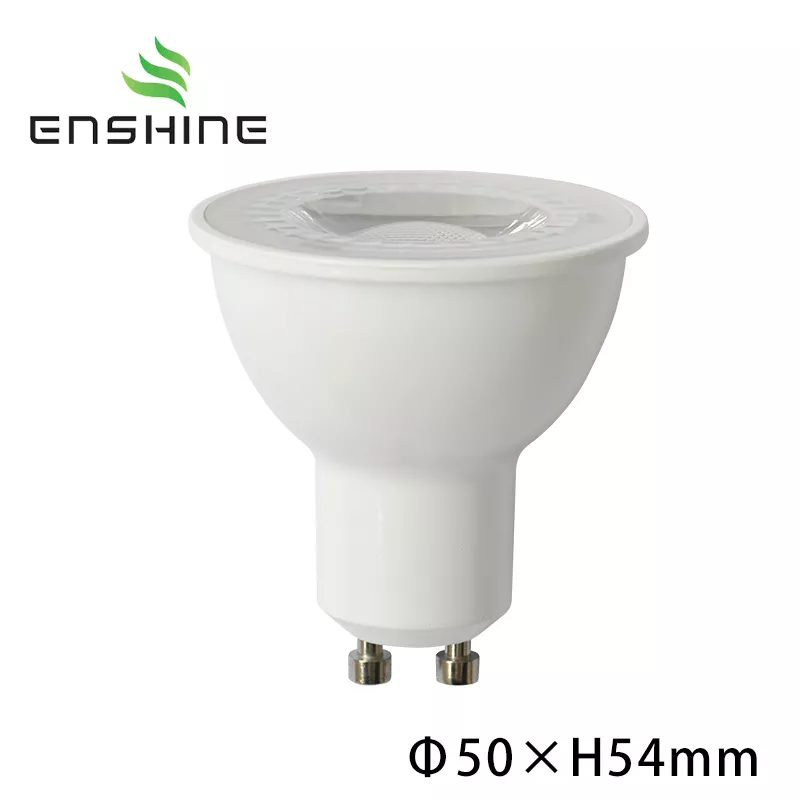
The GU10 base is a twist-and-lock two-pin base. The pins are thicker and spaced wider than MR16 pins, and the lamp locks into the socket with a quarter turn. GU10 lamps connect directly to mains voltage, so no external transformer is needed. Our GU10 LED spotlights are rated AC90-265V, covering common mains voltages worldwide.
Because the GU10 socket receives mains voltage directly, the LED replacement must be designed for that input. A GU10 LED that is only rated for 12V would be damaged if connected to mains, and a 12V MR16 LED will not light in a GU10 socket without a compatible supply. Always match the lamp’s voltage rating to the socket’s supply.
MR16 base explained
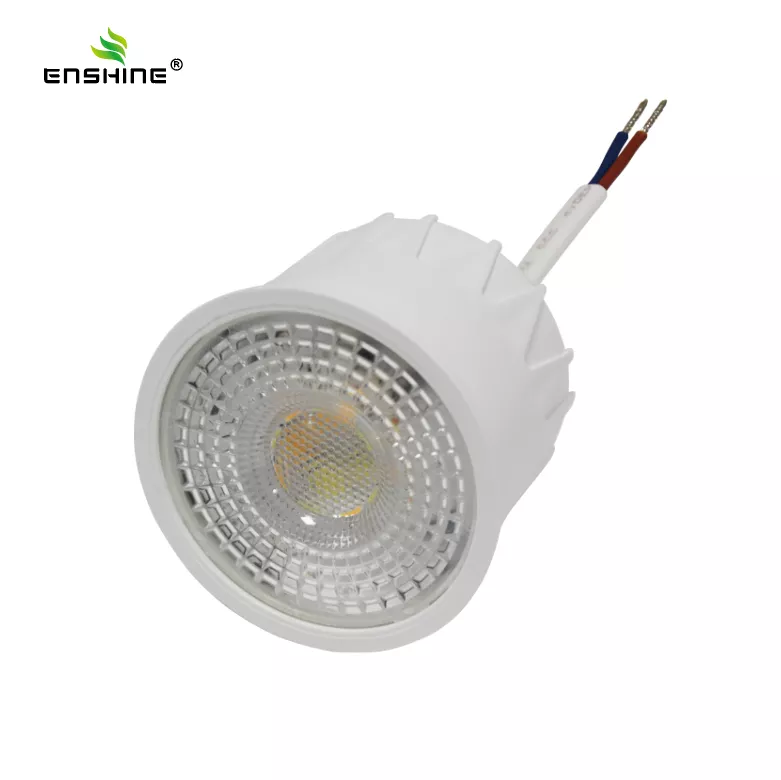
The MR16 base is a two-pin push-fit base. The pins are thinner and closer together than GU10 pins, and the lamp pushes straight into the socket. In many existing installations, MR16 lamps run on a low-voltage supply — commonly 12V — provided by a separate transformer or driver. Replacing a halogen MR16 with an LED MR16 often requires checking that the transformer is compatible with LED loads. Some transformers may not operate correctly with low-wattage LED lamps, so it is important to confirm the existing supply before replacing.
Our Glass LED Spotlight GU10 COB (YX-SPC6) is rated for AC90-265V mains input, and its specification also lists DC12V operation — so confirm the exact input range of the version you order with the supplier before matching it to an existing supply. In all cases, the base type must still match the socket: a GU10 base will not fit an MR16 socket and vice versa.
Key differences at a glance
| Feature | GU10 | MR16 |
|---|---|---|
| Base type | Twist-and-lock, two thick pins | Push-fit, two thin pins |
| Typical voltage | Mains voltage (AC90-265V) | Low voltage (commonly 12V) via transformer/driver |
| Transformer required | No | Often yes (check existing supply) |
| Common installation | Direct to mains, track lights, downlights | Low-voltage systems, older downlights with transformers |
Replacement checklist
Before ordering LED replacements, work through these points to avoid mismatches.
1. Match the base
Identify the existing socket: GU10 or MR16 (also called GU5.3). The LED lamp must have the same base. Our LED Spotlight Bulb (YX-SPC2) comes in 5-7W versions with GU5.3 (MR16-style) base and 8W/9W versions with GU10 base, so you can specify the correct base for the project.
2. Check the supply and transformer
For GU10, confirm the supply is mains voltage. For MR16, find out whether the existing lamp runs on 12V through a transformer. If so, verify that the transformer is suitable for LED loads. Some transformers have a minimum load requirement; an LED lamp with lower wattage may not draw enough current to trigger the transformer. Practical checks: read the transformer label for its stated minimum load and output type, prefer drivers that are marked as LED-compatible, and replace the transformer or choose a lamp designed for the existing supply where the two do not match.
3. Check size clearance
LED lamps can differ in dimensions from the halogen lamps they replace. Measure the available space inside the fixture, including height and diameter. For reference, the YX-SPC2 spotlight has dimensions Φ50×H46/H54/H68mm depending on wattage, and the YX-SPC6 is Φ50×H52mm. Compare these with the clearance in your fixture.
4. Decide CCT and CRI needs
Color temperature (CCT) affects the look of the space. Our LED spotlights are available in 2700-7000K, covering warm white to cool daylight. CRI (Color Rendering Index) indicates how accurately colors appear under the light. A CRI>80 is common for general lighting. The spotlights referenced in this guide are rated CRI>80; if a project requires a higher CRI, confirm the available options with the supplier before ordering. For projects where color temperature may need adjustment after installation, a switchable 3CCT module can be useful.
Where a 3CCT retrofit module helps
When replacing GU10 or MR16 lamps in existing fixtures, the housing often stays in place. A retrofit module designed to reuse the existing housing can simplify the upgrade. The MR16 Module 3CCT is a 5-8W LED module with AC90-265V input and switchable 3CCT, allowing selection among three color temperatures. The module has CRI>80 and PF>0.5, and this model is CE/RoHS/ETL/CB certified. It is designed to replace GU10 or MR16 lamps while keeping the existing housing, which can reduce labor and waste on larger retrofit projects.
For buyers sourcing for multiple sites, a module that covers both GU10 and MR16 replacements and offers selectable CCT can reduce SKU count while maintaining flexibility.
FAQ
Can I use a GU10 LED bulb in an MR16 socket?
No. The bases are physically different: GU10 has a twist-lock base with thicker pins, while MR16 has a push-fit base with thinner pins. They are not interchangeable without changing the socket or using an adapter (which may not be suitable for all installations).
Do I need to replace the transformer when switching to LED MR16?
Not always, but it depends on the transformer type and the LED lamp’s compatibility. Some transformers work fine with LED loads, while others may cause flickering or fail to start. Check the transformer specifications or consult the supplier. If in doubt, a qualified electrician can test the setup.
What does 3CCT mean?
3CCT means the lamp or module offers three selectable color temperatures, typically via a switch on the product. This allows one SKU to cover multiple color temperature requirements, which can be useful for distributors and contractors.
For more details on specific models, refer to the product pages linked above. Always confirm the existing supply and physical dimensions before placing an order.