
SEO
How to Choose Outdoor Solar Flood Lights: Battery, Control and Mounting
A practical B2B buyer's guide to selecting outdoor solar flood lights for yards, storefronts, walls, signage and worksites. Covers battery capacity and chemistry, charging time, control modes, mounting scenarios and what to confirm with a solar flood light manufacturer before ordering.
Outdoor solar flood lights make sense where pulling a mains cable is expensive, disruptive or simply not possible. Yards, storefront facades, wall-mounted signage and temporary worksites are common examples: the light goes where you need it, charges from daylight and switches on without trenching. But solar flood lights are not a single product category. Battery capacity and chemistry determine how long the light runs after dark, the panel determines how fast it recovers, control modes decide when it turns on, and mounting decides whether the installation survives its first storm.
This guide walks through those four decisions in the order that matters for most B2B buyers: battery first, then panel and charging, then controls, then mounting scenarios. It uses three real models from our range to show how the specification choices differ.
- Battery capacity and chemistry are the main drivers of runtime and rainy-day backup. Lithium batteries suit compact, lower-power fixtures; LiFePO4 suits higher-power fixtures and longer autonomy.
- Charging time depends on panel wattage and sunlight. A larger panel shortens recovery time and improves rainy-day resilience.
- Control modes available on our models are light control, time control and remote control. If motion sensing is required, confirm with the supplier.
- Mounting position should match beam angle and body material: wall and facade for wide coverage, bracket-mounted for portable or angled use.
- Before ordering, confirm IP rating, battery cycle life, warranty terms and whether the model supports the control modes you need.
Battery: Capacity, Chemistry and Rainy-Day Autonomy
The battery is the first thing to look at, because it sets the limit on how long the light can run when the panel is not producing. Two numbers matter: capacity in mAh (or Wh) and chemistry.
Capacity: match it to nightly runtime
Capacity should be read together with the wattage of the light and the working time the supplier states. Higher-wattage fixtures consume more energy per hour, so a larger battery is needed to deliver the same runtime. In our range, the YX-FL-02-SO solar flood light is available in 30W, 50W and 100W versions with built-in lithium batteries of 3.7V 3600mAh, 4800mAh and 10000mAh respectively, matching the three wattage steps. Working time is approximately 3–5 hours or 4–6 hours depending on model and setting.
For higher-power installations, the YX-FL-03-SS IP65 solar floodlight uses a LiFePO4 battery in 3.2V 20000mAh or 30000mAh versions for its 200W and 400W models, with a stated backup of 2–3 rainy days. That rainy-day figure is the one to ask about for any project where the light must stay on through consecutive overcast days.
Chemistry: lithium vs LiFePO4
Lithium batteries (often lithium-ion or lithium-polymer) are common in compact, lower-power solar flood lights. They are lighter and cost-effective for fixtures where the battery sits inside the lamp body. LiFePO4 (lithium iron phosphate) batteries are chosen for higher-power and larger-capacity systems. They are heavier and usually more expensive, but they are the chemistry used in our 200W and 400W models where longer autonomy and a higher cycle life are the priority.
For a buyer comparing options, the practical question is not which chemistry is “better” in general, but which matches the project: a compact wall light for a storefront may be well served by a lithium battery, while a worksite flood light that runs every night and must survive cloudy weeks may justify LiFePO4.
Reading the runtime figures correctly
Runtime figures are approximate and model-dependent. They are typically quoted at a given brightness setting; running a light at full output shortens runtime, and dimming or using a shorter timed period extends it. When comparing suppliers, ask for the runtime at the setting you intend to use, not just the headline maximum.
Solar Panel and Charging Time
The panel determines how quickly the battery recovers. A larger panel produces more energy per hour of sunlight, so it can recharge a larger battery in a comparable time or recharge a smaller battery faster. In our range, the YX-FL-02-SO uses a 5V 1.5W solar panel, with charging time approximately 8–10 hours depending on model and setting. The YX-FL-03-SS uses a monocrystalline panel, 25W or 45W at 6V, matching the 200W and 400W models.
Charging time is always approximate because it depends on sunlight intensity, panel orientation and season. For project planning, the useful comparison is the ratio between charging time and working time: a light that charges in 8–10 hours and runs 4–6 hours needs a reasonable daily solar window to stay ahead. A larger panel or a battery with rainy-day backup (as on the YX-FL-03-SS) gives more margin in poor weather.
Panel type matters too. Monocrystalline panels, as used on the YX-FL-03-SS, are common in higher-power solar flood lights. The YX-FL-02-SO uses a 5V 1.5W panel suited to its compact body.
Control Modes: Light Control, Time Control and Remote
Control modes decide when the light operates and how much flexibility the installer or end user has after installation. The modes available on our models are:
- Light control: the light switches on automatically when ambient light falls below a threshold and off when daylight returns. This is the basic mode for unattended operation.
- Time control: the light runs for a set duration after switching on. This limits battery draw and can align operation with business hours or site schedules.
- Remote control: a handheld remote allows the user to switch the light on or off and, on models that support it, adjust settings without accessing the fixture. The YX-FL-03-SS includes light control, time control and remote control.
One point to be clear about: our current models do not list motion or PIR sensor capability. If a project requires motion-triggered operation, confirm available options with the solar flood light manufacturer before specifying. Do not assume motion sensing is included based on the product category alone.
For most buyers, the choice comes down to how much control the end user needs. A yard light that simply comes on at dusk may need only light control. A storefront or signage light may benefit from time control to match opening hours. A worksite light that is set up and adjusted by different crews may justify a remote.
Mounting Scenarios: Wall, Yard, Storefront, Worksite and Portable Use
Mounting is where specification meets installation. The right body material, beam angle and bracket depend on where the light goes.
Wall and facade mounting
Wall mounting is the most common arrangement for solar flood lights. The fixture is fixed to a wall or facade, and the panel is either integrated into the body or mounted separately. The YX-FL-03-SS is a split-type design with a separate panel, which allows the panel to be positioned for better sun exposure while the light is aimed at the target area. Its 90° beam angle suits wide coverage of a yard, driveway or building face. The YX-FL-02-SO is available with an ABS+PC or ABS+tempered glass body and is IP65 rated, making it suitable for outdoor wall installation.
Yard and perimeter lighting
For yards, the priorities are coverage and autonomy. A wide beam angle and a battery with rainy-day backup are more useful than a very narrow, bright spot. The YX-FL-03-SS, with its 200W or 400W options, LiFePO4 battery and 2–3 rainy-day backup, is intended for this kind of duty. The 6500–7000K color temperature gives a cool white light that is typical for security and area lighting.
Storefront and signage
Storefront and signage lighting usually needs a compact fixture that can be mounted on a wall or above a sign, with controls that match business hours. The YX-FL-02-SO, with its 30W, 50W and 100W options and IP65 rating, is a fit for this scale. Time control and remote control (where available) allow the light to be scheduled or adjusted without rewiring.
Worksite and temporary installations
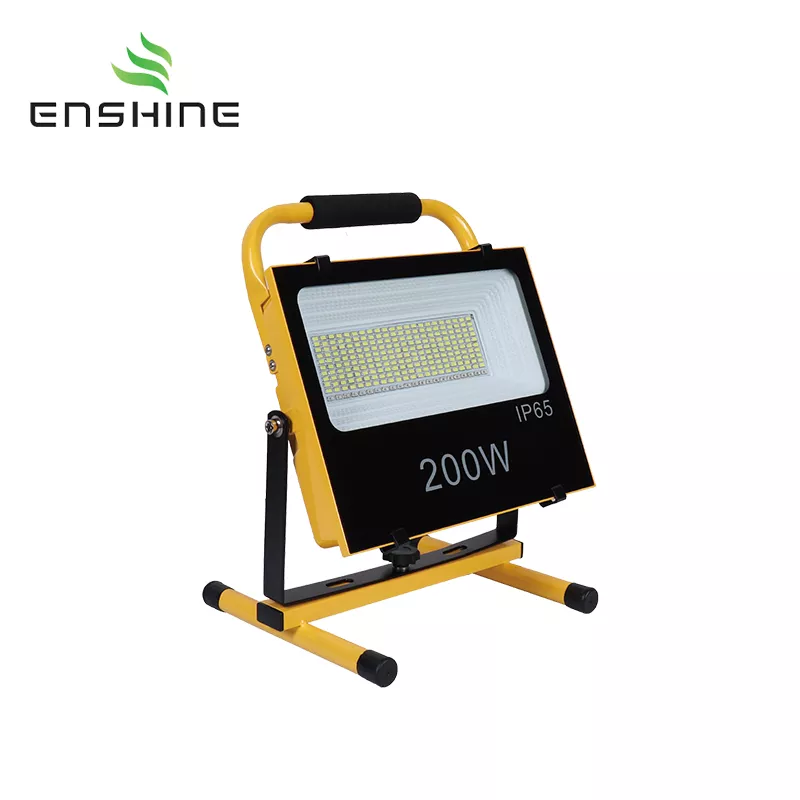
Worksites and temporary installations need lights that can be moved, re-aimed and set up without permanent wiring. The YX-FL-01-SO portable solar work light is designed for this: 50W, 100W, 200W and 300W options, a 5000–15000mAh battery, working time approximately 4–6 hours or 6–8 hours, charging 4–8 hours, IP65 rating, die-cast aluminium and tempered glass body, and a 360° adjustable bracket that allows the light to be aimed in any direction.
The table below summarizes how the three models map to common mounting scenarios:
| Model | Power options | Battery | Typical mounting scenario |
|---|---|---|---|
| YX-FL-02-SO | 30W, 50W, 100W | 3.7V 3600/4800/10000mAh lithium | Wall, storefront, signage |
| YX-FL-03-SS | 200W, 400W | 3.2V 20000/30000mAh LiFePO4 | Yard, perimeter, wide-area facade |
| YX-FL-01-SO | 50W, 100W, 200W, 300W | 5000–15000mAh | Worksite, portable, temporary |
What to Confirm with a Solar Flood Light Manufacturer Before Ordering
Specifications on a datasheet answer most questions, but a few points are worth confirming directly with the supplier before placing an order, especially for project buyers and distributors.
- IP rating: All three models mentioned here are IP65, which means protection against dust and water jets. Confirm that the rating applies to the complete installed unit, including cable entries and the panel connection on split-type models.
- Battery cycle life: The datasheet may not state cycle life. Ask the manufacturer for the expected number of charge cycles for the specific battery used, and how that relates to the warranty period.
- Warranty terms: The YX-FL-02-SO and YX-FL-03-SS carry a 3-year warranty; confirm what the warranty covers (battery, LED, panel, controller), the warranty term for the exact model you order, and what the buyer needs to provide for a claim.
- Control modes: Confirm which control modes are included on the exact model and version you are ordering, and whether a remote is supplied or optional.
- Motion sensing: If the project requires motion or PIR sensing, ask specifically whether it is available. Our current models do not list this feature.
- Spare parts and documentation: For distributor orders, confirm availability of spare batteries, panels and mounting hardware, and whether installation instructions in the target language can be supplied.
FAQ
How long do outdoor solar flood lights run on a full charge?
Runtime is approximate and model-dependent. In our range, the YX-FL-02-SO runs approximately 3–5 hours or 4–6 hours depending on model and setting, and the portable YX-FL-01-SO runs approximately 4–6 hours or 6–8 hours. The YX-FL-03-SS is stated to provide backup for 2–3 rainy days. Always confirm runtime at your intended brightness setting with the supplier.
Do these solar flood lights have motion sensors?
Our current models list light control, time control and remote control, but not motion or PIR sensing. If motion detection is a requirement, confirm available options with the manufacturer before ordering.
Can the solar panel be mounted separately from the light?
The YX-FL-03-SS is a split-type design with a separate panel, which allows the panel to be positioned for better sun exposure. The YX-FL-02-SO and YX-FL-01-SO have integrated panels. Check the specific model's mounting instructions for details.
Choosing outdoor solar flood lights comes down to matching battery capacity and chemistry to the required runtime, sizing the panel for the available sunlight, selecting the control modes the application needs, and mounting the fixture where it can charge and cover the target area. For distributor and project buyers, the next step is to confirm the specifications above with the manufacturer and request datasheets for the exact models under consideration.