SEO
LED High Bay Light Manufacturers: What to Verify Before You Place an Order
A distributor's or project buyer's pre-order checklist for industrial LED high bay suppliers. Seven items you can verify with documents, test records and samples — covering driver and voltage configuration, photometric claims, environmental testing, warranty terms and pilot-to-mass-production consistency.
Buyer checklist
Quotation sheets look alike. What separates industrial LED high bay suppliers is whether they can hand you documents, records and sample results that back each line of the quote. Here is what to ask for before the order goes out — and what a satisfactory answer looks like.
- Verify the driver brand and voltage range in writing, not from the spec photo.
- Ask for photometric and safety test records tied to the exact model you are buying.
- Confirm that warranty wording names the covered components and the remedy.
- Compare the pilot sample with a mass-production unit from the actual running line.
Buyers searching for LED high bay light manufacturers usually arrive at a shortlist of factories whose catalogs read the same: IP65, high lumen output, long life, five-year warranty. The words are identical because the specs are written from the same template. The difference sits in what the factory can prove when you ask. Below are seven items you can verify before you commit a warehouse, factory or logistics-center lighting project to a supplier.
- Driver brand and voltage range
- Test records tied to the model
- In-house test capability
- Warranty terms in writing
- Sample-to-mass-production consistency
- Customization and private label scope
- Production control and documentation
1. Driver brand and voltage range
The driver is the part most likely to fail first in a high bay installation, and it is the part most often left vague on a quote. "High-quality driver" is not a verification. Ask the supplier to state the driver brand, model family and input voltage range on the quotation itself.
- Check: Named driver brand and the input voltage window, including the top and bottom of the range.
- How: Request the driver datasheet and a photo of the driver label on a production unit, not a catalog rendering.
- Passes when: The voltage range covers every site you supply — for example 100–277V where North American and other networks sit inside one window — and the model on the label matches the quote.
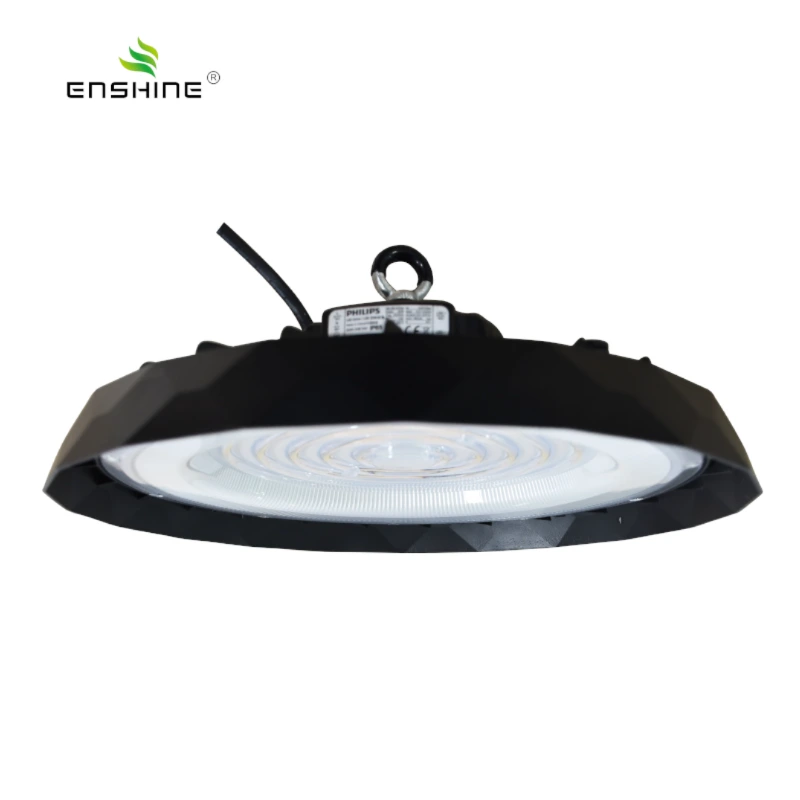
As a working example, Enshine's Philips-driver high bay line lists Philips drivers across its 100W, 150W and 200W models, with a 100–277V input range and power factor above 0.9. Those are the numbers to look for on a datasheet you can compare line by line — the point is not the brand name alone, but that the brand, model and range are documented and consistent across the whole order.
2. Photometric and electrical claims tied to a specific model
Lumen-per-watt figures are the easiest number to inflate. A catalog page can claim a headline efficacy while the actual tested unit sits lower. Before ordering, request a photometric test report that identifies the model and configuration you are buying, not a generic family report.
- Check: Lumen output, efficacy and power factor claimed for the exact wattage under consideration.
- How: Ask for the test report and cross-reference the model code, chip count and driver against the quote.
- Passes when: The report names the same model, and the efficacy figure on the report is at or above what the quote promises.
Watch for lines where efficacy varies by wattage — many families are lower at the smallest size. Enshine's Philips-driver range, for instance, lists 120 lm/W at 100W and 150 lm/W at 150W and 200W, with chip counts of 200, 440 and 600 across the three sizes. If your project mixes wattages, asking for a record per wattage is reasonable because the numbers are not the same.
3. In-house test capability behind the claims
Test reports tell you what a sample did on one day. The equipment behind the reports tells you whether the factory can keep testing as orders repeat. Ask what testing the supplier performs in its own facility and which checks are done by external labs.
- Check: Which tests run in-house — photometric, ingress protection, surge and EMI, aging — and how often.
- How: Request a list of test equipment and the routine test applied to every production batch versus the type tests done once per model.
- Passes when: Claimed IP65 and electrical ratings are supported by tests the factory can describe, and you understand which are batch checks and which are one-time model qualifications.
Enshine operates its own integrating-sphere photometric testing, an IP test chamber, surge and EMI equipment and a high-temperature aging room, and holds ISO 9001. For a buyer, that means the IP65 and electrical claims on the datasheet have a facility behind them — but you should still confirm that the record you receive is for your model, and that aging is part of routine output rather than only a launch sample.
4. Warranty terms you can hold a supplier to
A "5-year warranty" line on a brochure is a promise without detail until the wording names what is covered and what happens when a unit fails. Ask for the warranty document, not the marketing sentence.
- Check: Covered components (driver, LED board, housing), exclusions, claim process and remedy (replacement, credit or repair).
- How: Read the warranty text alongside the quote, and confirm the term applies to the model and quantity you are ordering.
- Passes when: The covered components and the remedy are stated, and the claim route (who you contact, what proof is needed) is clear before you order.
Both of Enshine's high bay lines — the Philips-driver models and the UFO high-efficiency range — carry a 5-year warranty as listed. That is a term to compare, not a guarantee of field reliability; a warranty is only useful if the covered parts and the claim process are defined in the document you sign with.
5. Sample-to-mass-production consistency
The pilot unit you approve and the units that arrive can diverge if the factory changes chips, drivers or housings between sample and production. Pin down how the factory controls that gap.
- Check: Whether the sample build and the production build use the same bill of materials.
- How: Ask for the sample's BOM and a production BOM for the same model, and request a pre-shipment unit from a running batch for comparison.
- Passes when: Chip brand, driver brand and housing are unchanged, and any substitution is disclosed and approved in writing before it ships.
For a logistics-center or warehouse project, which often mixes multiple wattages and mounting positions, a single approved sample is not enough. Confirm that each wattage in the order is built to the configuration you tested.
6. Customization and private-label scope
If you are a distributor putting your own brand on the product, ask what the factory will change and what stays fixed. This separates a genuine OEM/ODM arrangement from a label swap.
- Check: What can be customized — branding, packaging, beam angle, color temperature, cable/connector — and what is fixed by the platform.
- How: Request a written customization list and a sample of the private-label version before committing.
- Passes when: The scope is documented and the lab sample reflects your label and requested options.
Enshine supports OEM/ODM, private label and sample requests, and runs its own SMT, die-casting, injection-molding and LED driver assembly lines — which is the kind of vertical setup that lets a factory control the housing and board rather than buy them finished. For a distributor, that matters when you want a specific beam angle or branding; for example, the UFO range lists a 90° beam angle, 6000–6500K, 150–160 lm/W and a 50,000-hour life, so confirm which of those are fixed and which are open to your spec.
7. Production control and the documents that travel with the order
Finally, establish what paperwork you will receive and what it proves. A management-system certificate covers a factory's processes; it does not certify each product model. Ask which documents attach to your shipment.
- Check: The test record per batch, the model-level test reports, and the QC sign-off on the shipment.
- How: Request the document set for a recent order of the same model, and confirm what will be issued for yours.
- Passes when: You know which documents prove batch testing versus model qualification, and both are accounted for.
Enshine holds ISO 9001, which describes its quality-management system. The specific product claims still need their own records — that is the difference between a certificate and a test report, and it is worth keeping straight when you compare suppliers.
What to put in writing before the order
Once the shortlist is down to two or three factories, send each the same request list: driver brand and voltage range, the model-specific photometric report, the warranty document, the in-house test list, the customization scope and the document package for shipment. Compare the answers side by side. A factory that answers all seven with documents is easier to hold to a specification than one that answers with adjectives.
You can review the two ranges referenced here on the high bay light category page, including the Philips-driver high bay and the UFO high bay. Use them as a reference for the level of detail to expect from any manufacturer's documentation, and send your own verification list before you order.
Ready to Start Your LED Lighting Project?
Tell us your product requirements, target market and order quantity. The Enshine team will get back to you with a quotation within two business days.