
Industry Knowledge
How to Vet an LED High Bay Light Manufacturer: A Buyer's Checklist for OEM/ODM Sourcing
A buyer's checklist for vetting an LED high bay light manufacturer: production lines, driver and chip configuration, testing labs, warranty, MOQ and OEM/ODM terms — with Enshine's Philips driver high bay line as a worked example.
Search LED high bay light manufacturer and you get hundreds of supplier pages that look the same: the same UFO-shaped fixtures, the same efficiency claims, the same warranty banner. The catalog tells you very little about who actually built the light, who owns the tooling, and who answers the phone when a batch starts failing in year two. That gap is where sourcing mistakes happen.
This checklist is written for lighting brand buyers, distributors and project contractors who have moved past comparing lumen tables and now need to judge the company behind the fixture. The criteria below are the ones we would apply when auditing any factory — use them on any supplier, including us.
1. Why the Manufacturer Matters More Than the Fixture
A high bay light hangs eight to fifteen meters above a working floor. When one fails, nobody swaps it like a light bulb: you need a lift, an electrician and a production stop window. If a share of a container load fails after year one and warranty claims stall, the replacement cost — labor, logistics, downtime — lands on the buyer, not on the factory that sold the container.
This changes what you should be evaluating. Two suppliers can offer a 150 lm/W UFO fixture with identical-looking datasheets and still be very different risks. The difference is not the lamp; it is whether the plant can build the ten-thousandth unit to the same standard as the approved sample, and whether the company will still be organized to honor the warranty in five years. That is why the vetting questions below are about manufacturing, configuration discipline and paperwork — not about the fixture photo on the catalog cover.
2. Verify Production Capability, Not the Catalog
The first question to any LED high bay light supplier is: which of the core processes do you run in-house? For a UFO high bay, the relevant processes are die casting (the aluminum housing and heat sink), SMT (placing the LED chips on the board), driver assembly, plastic injection (lenses and diffusers), and final assembly.
A factory that runs die casting in-house controls the wall thickness and thermal mass of the housing — a decisive factor for LED lifetime at high ambient temperatures. A factory that assembles its own drivers controls the component that statistically fails first. A factory that buys housings from one vendor and drivers from another is, functionally, a trading company with a quality office. Its pricing may be competitive, but when a process problem appears it can only reject the batch, not fix the cause.
As a concrete reference: Enshine Lighting was founded in 2006 and employs 300+ people, with plastic injection, aluminum stamping, die casting, LED driver assembly and complete product manufacturing all in-house. When you audit any supplier, ask for photos or a live video walkthrough of each claimed line, and ask which of those lines your high bay actually passes through. An injection line that makes batten diffusers proves nothing about your high bay order.
3. Driver and Chip Configuration: the Questions That Separate Real Manufacturers
The driver is the first component to fail in most LED high bay failures, so pin it down before anything else:
Which driver brand and model? "High-quality driver" is not an answer. You want brand and model, in writing, on the proforma invoice.
Input voltage range? For export projects, a 100–277V range covers most markets. A fixture specced only at 220V will misbehave on unstable grids.
Power factor? At industrial scale, PF above 0.9 should be standard, not an upgrade option.
Who carries the driver warranty? If the driver is bought in, ask what arrangement the supplier has with the driver maker.
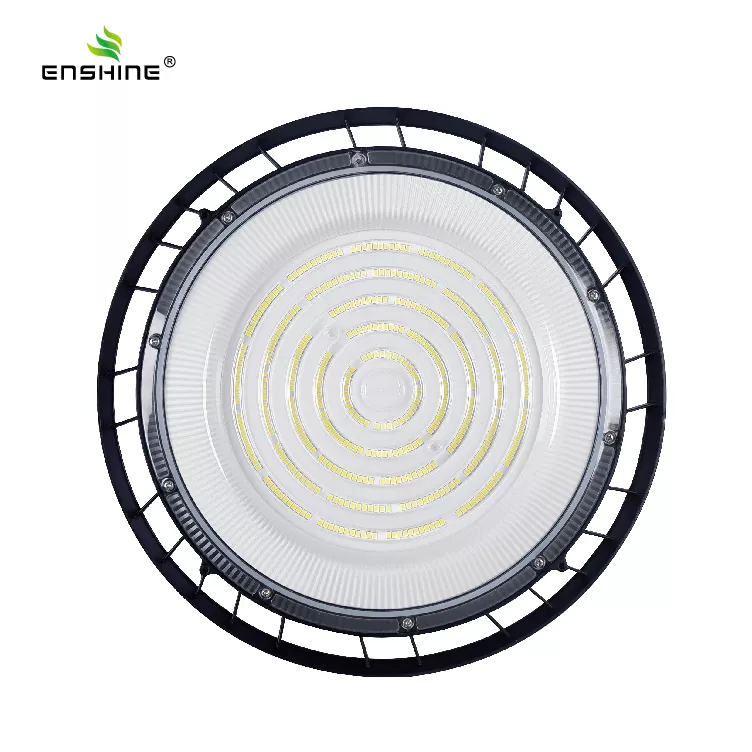
Then the chips. Ask for the brand and the count per power version. The count matters because the same wattage built with fewer chips runs each chip harder and hotter, which shortens life. For example, our Philips driver high bay line uses Sanan LED chips — 200 chips at 100W, 440 at 150W and 600 at 200W — so the chip count scales with power and keeps the drive current per chip moderate.
Ask the same question about efficacy. In that line, the 100W version delivers 120 lm/W while the 150W and 200W versions reach 150 lm/W. Real measurement varies by configuration; a datasheet showing one flat number across all wattages was often copied rather than tested. If a supplier cannot explain the difference between two versions of its own product, that tells you who wrote the datasheet.
If you need the fixture-side selection logic — wattage by ceiling height, beam angle, lumen targets — we cover it in How to Choose UFO High Bay Light for Warehouse & Industrial Lighting. This article deliberately stays on the manufacturer side of the decision.
4. Testing Evidence You Should See Before Committing
Any serious LED lighting manufacturer runs a lab. The questions are which tests exist, whether they cover the fixture you are buying, and whether reports are issued per model. Six capabilities worth confirming on-site or by video:
Integrating sphere and photometric testing — verifies the lumen and lm/W figures on the datasheet for your actual model, not a family average.
High-temperature aging chamber — runs drivers and complete fixtures at elevated temperature to catch early failures before shipment.
IP rating test chamber — substantiates the IP65 rating printed on the box.
Surge and EMI test equipment — relevant wherever the grid is unstable or the switching load is large.
Salt spray corrosion tester — matters for coastal sites and food-processing environments that corrode housings and fasteners.
Spectral colorimeter and CRI analysis — checks CCT and CRI consistency across the batch, not just the sample.
Enshine maintains these six test capabilities in-house, alongside ISO 9001 quality management certification. One caution for your audit checklist: a management-system certificate covers the factory's process, not every product. Ask which standards the specific high bay model has been tested against, and request the test report for that model number. A certificate on the wall does not substitute for a report with your model on it.
5. Warranty, MOQ and OEM/ODM Terms to Negotiate
Warranty. A 5-year warranty — standard on our Philips driver high bay line — is only as good as its terms. Ask three things: does coverage apply to the whole fixture or the driver only; who pays freight on warranty replacements; what evidence is required to file a claim. Get the answers written into the contract, not left in the catalog.
MOQ and samples. Confirm the sample policy before you evaluate the bulk quote. A manufacturer that is confident in its production runs samples before bulk production as a standard step; a supplier that pushes you straight to a container order is asking you to finance its quality control.
OEM/ODM scope. "OEM/ODM available" on a banner means little by itself. Ask what is actually customizable: private labeling and packaging are entry level; specification changes, housing modifications and alternative drivers require engineering involvement. Ask who owns the tooling for a customized housing — if the supplier owns it, you have less leverage if you move the order later.
Export handling. Confirm the export packaging standard for sea freight and whether shipping documentation for your market is prepared in-house.
6. The Ten-Point Supplier Audit Checklist
Core processes in-house: die casting, SMT and driver assembly for the high bay specifically.
Evidence for each claimed production line — photos, video walkthrough, or a visit.
Driver brand, model and input voltage range written on the proforma invoice.
Chip brand and chip count for each wattage version.
Efficacy explained per version, with the reason any figure changes across the range.
Test reports that match the specific model number you are ordering.
Lab capabilities on site: integrating sphere, aging, IP, surge, salt spray, colorimetry.
Warranty terms in the contract: scope, freight split, claim evidence.
A defined sample policy before bulk production.
OEM/ODM scope and tooling ownership defined in writing.
Once you have shortlisted two or three factories, apply the fixture-side criteria from How to Choose the Right LED High Bay for 20–40 ft Ceilings to match wattage and output to your actual building.
7. Frequently Asked Questions
Is an on-site audit necessary, or is a video call enough?
For a first container order of a customized fixture, an on-site or third-party audit of the claimed production lines is standard practice. If travel is not practical, a live video walkthrough is a reasonable second best — ask the host to walk the die casting and driver assembly areas and show the test lab in the same call. What you are verifying is that the lines exist and run, which a slideshow cannot prove.
Should I chase the lowest price or the highest lm/W figure?
Neither on its own. A higher lm/W only pays back if the measurement is real and the thermal design supports it; a lower price only pays back if the failure rate over five years is acceptable. Normalize quotes first — driver brand and model, measured efficacy for your model, warranty terms — and then compare price. A quote that is cheaper because the driver is unbranded is not cheaper.
How do I compare two quotes with different drivers?
Put both on the same basis: identical wattage, identical photometric test conditions, same warranty duration, same freight terms for warranty claims. If one supplier offers a branded driver with a 100–277V input range and the other offers an unbranded driver at 220V, the price gap reflects configuration, not just margin. Decide which configuration your market needs, then compare.
What should my first RFQ contain?
Wattage or installation height, quantity, target market and voltage, application (warehouse, factory, logistics center), and any branding or packaging requirements. The more of this you state upfront, the closer the first quotation is to the final one, and the fewer assumptions you have to audit later.
Checking an LED High Bay Manufacturer Yourself
If you are currently vetting an LED high bay light manufacturer for a distribution line or a project, you can apply every item on this checklist to us. Our sales team can send the specification sheet, sample arrangements and an OEM/ODM quotation for the LED High Bay Light with Philips Driver — send your wattage, quantity and target market, and we will reply with product details and quotation.