
Industry Knowledge
What Is CRI in LED Lighting? CRI 70 vs CRI 80 vs CRI 90 vs CRI 95
A practical B2B guide to CRI in LED lighting: what CRI (color rendering index) means, how Ra and R9 are measured, how CRI 70/80/90/95 differ, how to choose the right level for each application, and how Enshine controls color rendering quality.
When choosing LED lighting, buyers often compare wattage, lumens, color temperature and energy efficiency. However, one important specification is sometimes overlooked: CRI (Color Rendering Index).
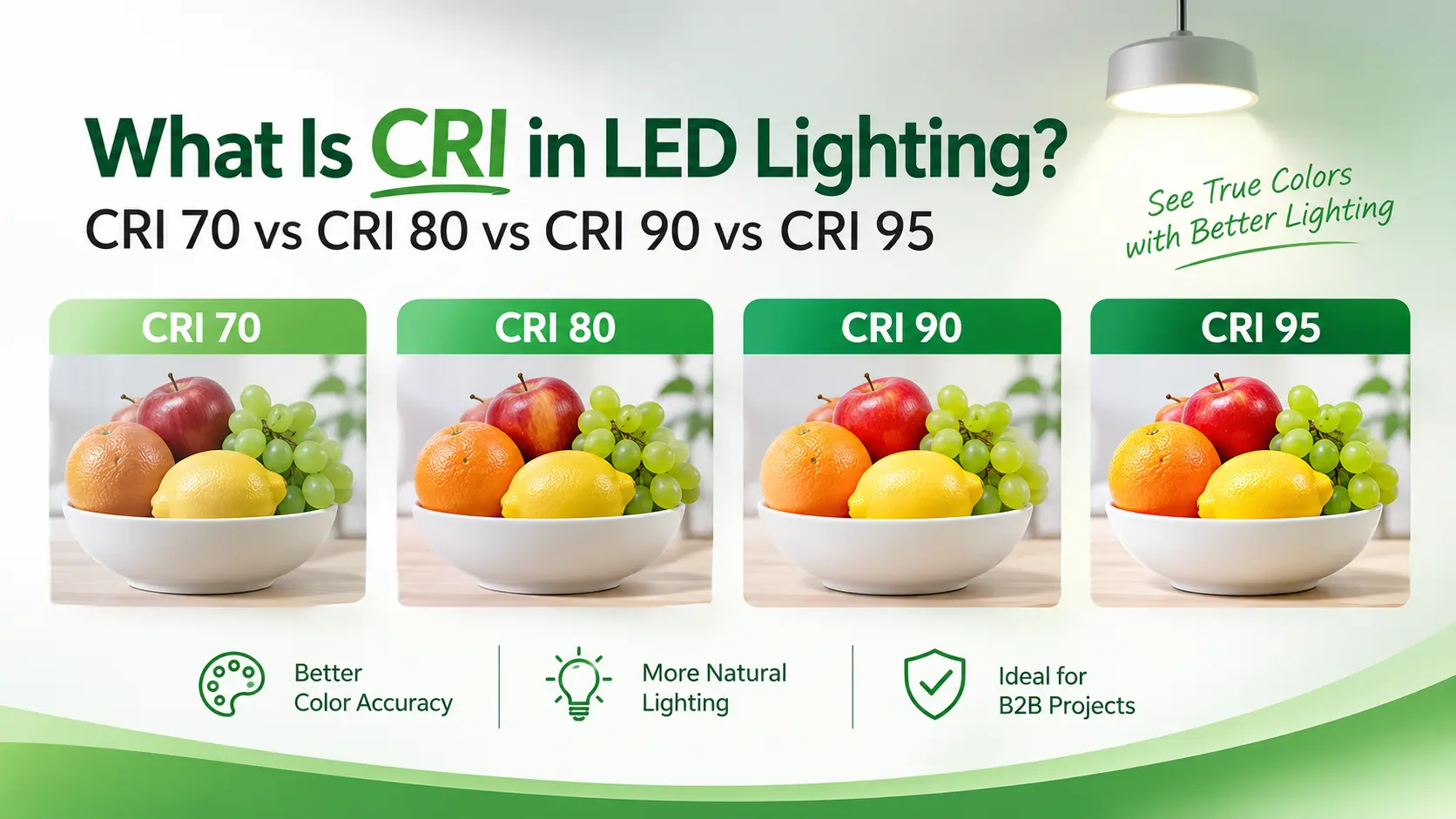
CRI determines how accurately a light source reveals the colors of objects compared with a reference light source. It is particularly important in retail stores, offices, schools, hospitals and other environments where natural-looking colors matter.
But what is the actual difference between CRI 70, CRI 80, CRI 90 and CRI 95? Does a higher CRI always mean better LED lighting?
In this guide, we explain how CRI works, compare different CRI levels and show how to select the right color rendering performance for different lighting applications.
1. What Is CRI in LED Lighting?
CRI stands for Color Rendering Index. It is a measurement used to evaluate how accurately a light source reproduces the colors of objects compared with a reference light source under comparable color temperature conditions.
CRI is generally expressed as a value from 0 to 100. A higher CRI indicates better average color rendering performance.
For example:
CRI 70: Basic color rendering, commonly used in some outdoor and industrial lighting applications.
CRI 80: Standard color rendering for general commercial and residential lighting.
CRI 90: High color rendering for retail, hospitality and professional environments.
CRI 95: Very high color rendering for applications requiring more accurate color presentation.
For LED lighting manufacturers, CRI is an important optical performance parameter. It helps buyers evaluate whether a lighting product is suitable for its intended application.
How Is CRI Measured?
The traditional CRI evaluation method compares the appearance of standardized color samples under a test light source and a reference illuminant.
The general CRI value, known as Ra, is calculated from the average performance of eight standard color samples (R1–R8).
One important detail for professional buyers is that the general CRI value does not include the saturated red sample R9.
This means two LED lights with the same CRI 90 rating may still perform differently when rendering saturated red colors.
For applications where color accuracy is particularly important, buyers should also request R9 values and, where appropriate, spectral power distribution (SPD) data.
2. CRI 70 vs CRI 80 vs CRI 90 vs CRI 95: What's the Difference?
Different CRI levels are designed to meet different lighting requirements. A higher CRI is not automatically necessary for every application.
Here is a quick comparison:
CRI Level | Color Rendering | Typical Applications |
|---|---|---|
CRI 70 | Basic | Outdoor lighting, roads, general industrial areas |
CRI 80 | Good | Warehouses, offices, residential and commercial lighting |
CRI 90 | High | Retail stores, hotels, restaurants and showrooms |
CRI 95 | Very High | Classrooms, galleries, color-sensitive environments |
CRI 70: Basic Color Rendering for General Lighting
CRI 70 is commonly used in applications where general visibility and lighting efficiency are more important than precise color reproduction.
Typical applications include:
Outdoor floodlighting
Street lighting
Large industrial areas
General security lighting
For example, Enshine's high-power outdoor LED floodlight range offers CRI ≥70, making it an option for general outdoor lighting projects where high color accuracy is not the primary requirement.
Explore our High Power LED Floodlight for more product details.
CRI 80: A Practical Choice for Everyday Lighting
CRI 80 is a common specification for general-purpose LED lighting.
It offers a practical balance between color rendering performance, product cost and application requirements.
Typical applications include:
Warehouses and factories
Offices and commercial buildings
Residential lighting
Corridors and public areas
General retail lighting
For many B2B lighting distributors, CRI 80 is a suitable standard specification for everyday commercial lighting products.
For example, Enshine's LED downlight range includes CRI >80 configurations for general indoor lighting applications.
View our LED Downlight Products.
CRI 90: Better Color Accuracy for Commercial Spaces
CRI 90 LED lighting provides more accurate color reproduction than standard CRI 80 lighting.
It is particularly useful in environments where the appearance of products, materials and interior finishes influences the customer experience.
Typical applications include:
Fashion and clothing stores
Hotels and restaurants
Beauty salons
Furniture showrooms
Premium residential spaces
For lighting distributors supplying commercial projects, CRI 90 can be a valuable product option when customers require better color presentation.
Enshine also offers LED downlight configurations with CRI >90 options, depending on the selected model and specification.
Explore our Recessed LED Downlight for available configurations.
CRI 95: High Color Rendering for Specialized Applications
CRI 95 is designed for applications where accurate color reproduction is especially important.
It can help colors appear more natural and details become easier to distinguish under artificial lighting.
Typical applications include:
Educational environments
Art galleries and exhibition spaces
Professional display areas
Specialized commercial lighting
Color-sensitive workspaces
Enshine has developed dedicated high-CRI lighting products for education projects.
Our LED Blackboard Light offers CRI >95 with a dedicated optical design for classroom applications.
We also offer Micro-Prismatic LED Classroom Lights with CRI >95 and UGR <16 performance.
Explore our LED Blackboard Light CRI 95+ and Micro-Prismatic LED Classroom Light.
3. Which CRI Level Should You Choose for Different Applications?
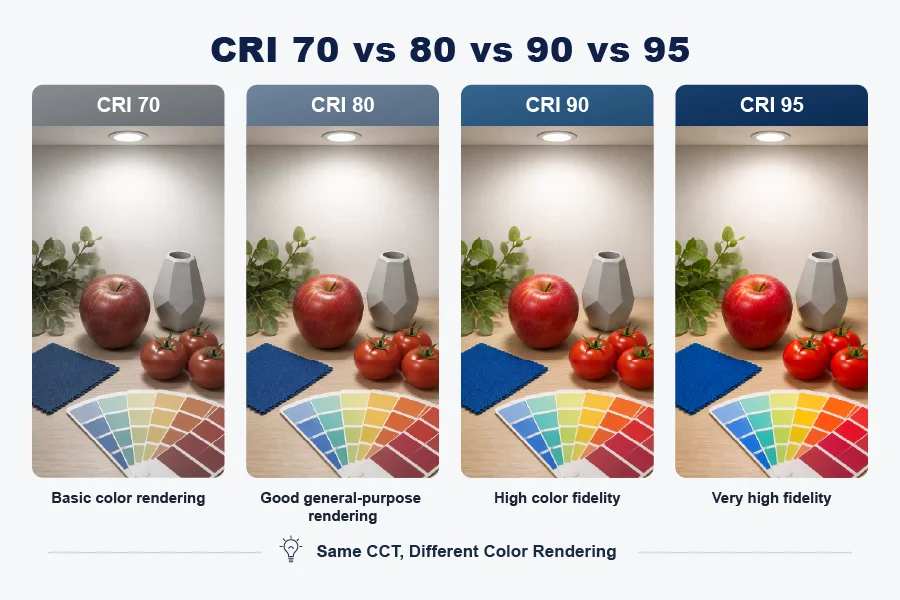
For importers, wholesalers and project contractors, the right CRI level depends on the intended application, customer requirements and project specifications.
Here is a practical selection guide:
Application | Suggested CRI | Why It Matters |
|---|---|---|
Outdoor security lighting | CRI 70+ | General visibility |
Roads and parking areas | CRI 70+ | Basic color recognition |
Warehouses and factories | CRI 80+ | General working visibility |
Offices | CRI 80+ | Comfortable everyday lighting |
Supermarkets | CRI 80–90+ | Better product presentation |
Clothing and furniture stores | CRI 90+ | More accurate product colors |
Hotels and restaurants | CRI 90+ | Natural-looking interior colors |
Classrooms | CRI 90–95+ | Clearer color presentation |
Art and display environments | CRI 95+ | Higher color accuracy requirements |
These are practical selection guidelines rather than universal regulatory requirements. Actual specifications should be confirmed against the project design and local standards.
Does Higher CRI Always Mean Better LED Lighting?
Not necessarily.
CRI is only one part of LED lighting performance.
A high-CRI light source may reproduce colors more accurately, but it does not automatically guarantee:
Higher brightness
Better energy efficiency
Longer service life
Lower glare
Better electrical safety
For professional lighting projects, buyers should evaluate CRI together with luminous efficacy, color temperature, optical design, flicker performance, thermal management and product reliability.
A balanced lighting specification is usually more important than simply choosing the highest CRI number.
4. CRI vs Color Temperature: What's the Difference?
CRI and CCT (Correlated Color Temperature) are two different lighting specifications.
CCT describes how warm or cool the light appears, while CRI describes how accurately the light reveals object colors.
For example:
3000K: Warm white light
4000K: Neutral white light
6500K: Cool daylight white
A 3000K LED light can have CRI 80, CRI 90 or CRI 95.
Likewise, a 6500K LED light can also achieve different CRI levels.
This means color temperature and color rendering should be evaluated separately when selecting LED lighting products.
For distributors sourcing products for different markets, offering multiple CCT and CRI configurations can help meet different project requirements.
5. How Does Enshine Control LED Color Rendering Quality?
As an LED lighting manufacturer with 20 years of manufacturing experience, Enshine understands that stable product performance is important for long-term B2B cooperation.
Color rendering performance is not determined by the LED chip alone. It also depends on the phosphor system, LED package, optical design, electrical components and manufacturing consistency.
At Enshine, our production and testing capabilities support product quality evaluation throughout the manufacturing process.
In-House Laboratory and Optical Testing
Our laboratory is equipped with professional testing instruments to evaluate key lighting performance parameters.
These include:
Integrating sphere testing for luminous flux and luminous efficacy.
Spectral and colorimeter testing for color temperature and color performance.
CRI analysis to evaluate color rendering characteristics.
Photometric measurements to assess lighting performance.
These measurements help verify product specifications and support the development of different lighting solutions.
Material Inspection and Production Quality Control
Reliable color performance also depends on consistent raw materials and manufacturing processes.
Enshine maintains quality control procedures covering incoming materials, production inspection and finished-product evaluation.
Our manufacturing capabilities include:
In-house plastic injection for lighting components.
Aluminum stamping and die-casting processes.
LED driver assembly and production.
Product inspection and performance testing.
These in-house capabilities help us manage important production stages and support OEM and ODM orders for international lighting brands and distributors.
Product Testing Before Shipment
In addition to optical measurements, Enshine uses aging tests and other relevant testing procedures to evaluate product reliability.
Our in-house testing facilities include high-temperature aging equipment and other product performance testing instruments.
For B2B customers, this means that product specifications and quality requirements can be discussed and checked during the development and production process.
Learn more about our LED Lighting Manufacturing Facilities and Testing Laboratory.
6. Why Should LED Lighting Distributors Pay Attention to CRI?
For LED importers and wholesalers, CRI is more than just a technical specification.
It can influence product positioning, target markets and customer satisfaction.
Here are three reasons why distributors should consider CRI when developing their LED product ranges.
1. Match Different Customer Requirements
Different customers have different lighting expectations.
A distributor supplying industrial lighting may mainly need CRI 70 or CRI 80 products, while a supplier specializing in premium commercial lighting may need CRI 90 or CRI 95 options.
Offering different CRI configurations allows distributors to serve more market segments.
2. Build a More Competitive Product Portfolio
A well-planned LED product portfolio should cover different price levels and application requirements.
For example, distributors can develop:
Standard LED downlights with CRI 80.
High-CRI downlights with CRI 90.
Specialized classroom lighting with CRI 95+.
General outdoor floodlights with CRI 70+.
This creates more flexibility when preparing quotations for different projects.
3. Request Reliable Test Data from Your Manufacturer
When sourcing high-CRI LED lights, buyers should not rely only on product descriptions.
Professional suppliers should be able to provide relevant technical specifications and test data for the exact product configuration.
Before placing an order, consider requesting:
CRI test reports
R9 data when color accuracy is critical
Spectral power distribution (SPD) curves
Color temperature and luminous flux data
Sample testing for product approval
For long-term orders, consistency between production batches should also be considered.
7. Frequently Asked Questions About LED CRI
Is CRI 80 good enough for LED lighting?
Yes. CRI 80 is suitable for many general lighting applications, including offices, warehouses, residential spaces and commercial buildings.
However, retail stores, showrooms and other color-sensitive environments may benefit from CRI 90 or higher.
Is CRI 90 significantly better than CRI 80?
CRI 90 generally provides better color rendering accuracy than CRI 80.
The difference can be more noticeable when viewing colored products, fabrics, furniture and decorative materials.
Whether the upgrade is worthwhile depends on the lighting application.
What does CRI 95 mean in LED lights?
CRI 95 indicates a high level of average color rendering performance under the standard CRI evaluation method.
It is commonly considered for specialized applications such as educational lighting, display areas and environments where accurate color appearance is important.
Does higher CRI reduce LED brightness?
Not necessarily, but higher color rendering requirements can influence LED package selection and luminous efficacy.
The actual brightness depends on the LED chips, driver, optical design and total fixture efficiency.
Buyers should compare the complete fixture's lumen output and lm/W performance rather than judging brightness by CRI alone.
What is the difference between CRI and R9?
CRI Ra is the average of eight standard color samples (R1–R8).
R9 measures how accurately a light source renders saturated red colors and is not included in the general Ra calculation.
For applications involving artwork, food displays, fashion and skin tones, R9 can provide additional information about color rendering performance.
Can LED lights have CRI 95 and 6500K at the same time?
Yes. CRI and CCT are separate specifications.
An LED light can be designed with high color rendering performance and a cool white color temperature, provided the LED package and optical design support the required specifications.
Conclusion: Choose the Right CRI for Your Lighting Application
Understanding the difference between CRI 70, CRI 80, CRI 90 and CRI 95 helps buyers make more informed LED lighting decisions.
For general lighting, CRI 80 is often a practical choice. For retail and hospitality projects, CRI 90 can provide better color presentation. For specialized educational and display applications, CRI 95 may be more suitable.
At Enshine, we provide LED lighting solutions with different color rendering specifications, supported by in-house manufacturing, product development and testing capabilities.
Whether you are an importer, wholesaler, lighting brand or project contractor, our team can help you identify suitable LED lighting products for your target market.
Looking for a reliable LED lighting manufacturer?
Contact Enshine to discuss your required CRI, wattage, color temperature, product type and OEM/ODM requirements.
Visit Enshine LED Lighting and contact our team for product details and quotations.