SEO
LED Panel Light Manufacturers: Factory Audit and OEM/ODM Evaluation Checklist
A practical checklist for B2B buyers evaluating LED panel light manufacturers, covering pre-audit preparation, production lines, in-house testing, OEM/ODM scope, sample-to-mass-production consistency, and commercial terms — with concrete evidence to request at each step.
Supplier Evaluation Guide
Sourcing LED panel lights through OEM or ODM means you are not just buying a product; you are depending on another company's production lines, quality control, and documentation for every shipment. A factory audit tells you what a supplier can actually do — but only if you know what evidence to request and what it proves. This checklist walks through six stages of evaluation, with specific items to check at each one. It is not a product selection guide; for that, see our panel light selection guide. This article focuses on the factory behind the product.
Key Takeaways
- Prepare a written specification and audit agenda before you travel; unstructured visits produce unstructured findings.
- Verify that key processes (injection molding, metal stamping or die-casting, SMT, driver assembly) are genuinely in-house, not subcontracted.
- Request evidence of in-house photometric, environmental, and electrical testing — not just a list of equipment.
- Define the full OEM/ODM scope in writing: color temperature, private label, packaging, driver customization, and documentation.
- Approve a golden sample and lock it with a signed specification before mass production begins.
- Address warranty, lead time, MOQ, and payment terms in the same document as the technical requirements.
Stage 1: Preparation Before the Audit
An audit is only as useful as the questions you bring. Before scheduling a visit, assemble a written package that the supplier can respond to in advance.
- Product specification sheet: dimensions, wattage options, lumen output, color temperature range, CRI, input voltage, driver type, mounting method, and expected lifetime hours. For example, if you need a 600×600 mm panel in three wattages, state them as 40W / 48W / 72W at the same size so the supplier can confirm which platform supports all three.
- Volume and delivery profile: estimated annual quantity, first-order quantity, and required lead time. This tells you whether the factory’s capacity matches your program.
- Compliance requirements: any certifications, test reports, or labeling rules your market requires.
- Audit agenda: which production areas you want to see, which test reports you want to review, and who from the supplier should attend (quality manager, engineering lead, sales).
Ask the supplier to confirm in writing whether the audit will include a live production run or a stopped line. A live run shows actual process control; a stopped line shows layout only. The distinction matters when you evaluate the production stage.
Stage 2: Production Lines and Process Ownership
A panel light is not assembled from purchased parts alone. The housing, heatsink, diffuser, light engine, and driver each have a manufacturing step. Verify which steps the factory performs itself.
| Process Step | What to Check | What It Proves |
|---|---|---|
| Injection molding (diffuser, end caps, clips) | Machine count, mold storage, active molds for your model | Control over optical component quality and supply continuity |
| Aluminum stamping or die-casting (housing, heatsink) | Press or casting equipment, tooling ownership | Dimensional consistency and thermal-path control |
| SMT (light engine assembly) | Line configuration, reflow profile records, AOI or visual inspection step | Solder-joint reliability and LED placement accuracy |
| Driver assembly | Whether drivers are built in-house or purchased; incoming inspection records | Electrical safety and compatibility between driver and light engine |
| Final assembly and aging | Assembly line layout, aging room capacity, burn-in duration records | Stability before shipment and early-failure screening |
If a supplier subcontracts any of these steps, ask which ones and how incoming quality is controlled. Subcontracted SMT, for example, is not automatically a problem, but it changes where you should focus your inspection.
As a reference point, Enshine Lighting’s production base in Hua’an, Fujian, China, covers injection molding, aluminum stamping, die-casting, SMT, LED driver assembly, and finished-lamp manufacturing in-house. That combination is what allows a supplier to control housing fit, thermal contact, and driver matching without relying on outside vendors. When you audit, ask for the same level of process ownership — or a clear explanation of what is outsourced.
Stage 3: In-House Testing Capability
Equipment lists are easy to produce. What matters is whether the equipment is used routinely and whether records exist for the models you are buying. Request the following, ideally with sample reports dated within the last twelve months.
- Photometric testing: an integrating sphere or goniophotometer report showing lumen output, efficacy, and color coordinates for the specific model. Confirm the report matches your model and wattage.
- Color consistency: spectral and chromaticity analysis (CRI, CCT, SDCM) for the production batch, not just a design target.
- Ingress protection: an IP test chamber and a report for the panel type you are buying, if the product claims a specific IP rating.
- Electrical stress: surge and EMI test equipment, with reports for the driver used in your configuration.
- Environmental endurance: high-temperature aging room records and salt-spray test capability for housing and finish.
- Routine production testing: hi-pot, ground continuity, power-on test, and burn-in duration on the line — not only in the lab.
The distinction between laboratory capability and routine line testing is critical. A lab report proves a design can meet a specification; line testing proves each unit is checked before shipment. Ask to see both.
For context, Enshine’s testing setup includes an integrating sphere, an IP test chamber, surge and EMI equipment, a high-temperature aging room, salt-spray testing, and spectral/chromaticity analysis, backed by an ISO 9001 quality management system. That is the kind of in-house scope that lets a supplier issue test evidence without sending samples to a third party each time. If a candidate factory lacks one of these capabilities, ask how it obtains the corresponding report and how often.
Stage 4: OEM/ODM Scope and Customization Boundaries
“OEM/ODM supported” is a broad phrase. Define exactly what the factory will customize and what remains standard. Use a written scope table.
| Customization Area | Items to Specify | Evidence to Request |
|---|---|---|
| Color temperature | Target CCT values, tolerance, whether 3-CCT switching is required | Chromaticity report for the custom CCT |
| Private label | Logo placement, printing method, label content and language | Label proof and a sample-labeled unit |
| Packaging | Retail or project packaging, carton markings, drop-test requirement | Packaging drawing and a pre-production sample |
| Driver and electrical | Input voltage range, dimming protocol, surge requirement | Driver specification and test report |
| Documentation | User manual, installation sheet, declaration of conformity wording | Draft documents for your review |
Where the factory offers standard platforms, ask which platform your customization will be built on and whether the changes affect certification. A private label change usually does not; a driver change often does.
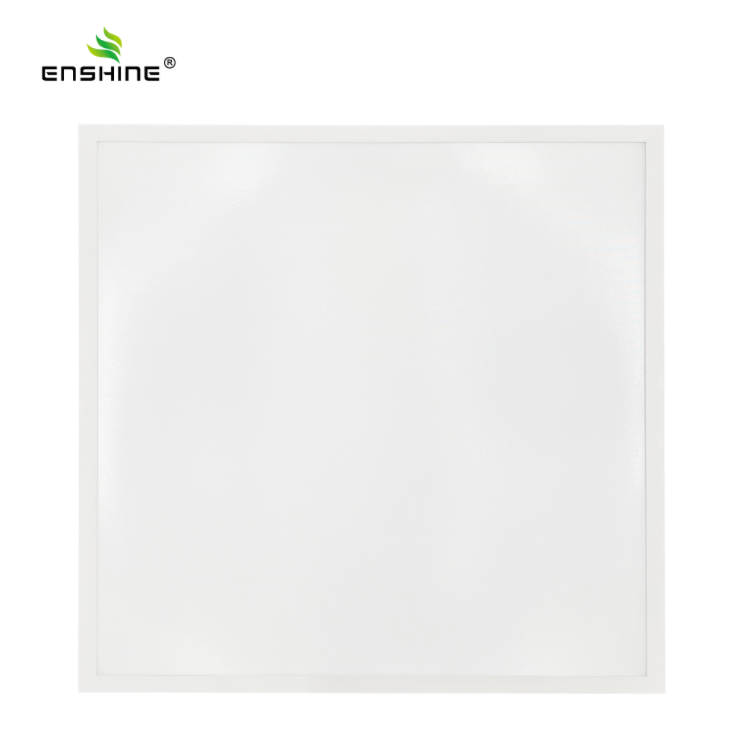
For a concrete example of what a standard OEM/ODM platform looks like, Enshine’s ultra-slim LED panel light is listed at 600×600 mm in 40W, 48W, and 72W versions at 90 lm/W, with 2700K–7000K color temperature range and CRI>80. The surface-mount panel light is listed in 6W, 12W, 18W, and 24W versions, round or square, with a built-in constant-current driver and overload/short-circuit protection. These platforms are the base on which color temperature, private label, and packaging customization are applied. When you evaluate another supplier, ask for the equivalent platform documentation so you can compare like with like.
Stage 5: Sample-to-Mass-Production Consistency
The most common failure in OEM sourcing is not a bad sample; it is a good sample followed by a different mass-production batch. Build a consistency protocol into the audit.
- Golden sample: approve one unit and record its measured lumen output, color coordinates, wattage, and appearance. Sign and date it.
- Specification lock: attach the golden sample to a written specification that lists every parameter, including tolerances. Both parties sign.
- Pre-production sample: before the full run, request 3–5 units from the actual production line (not from the lab) and compare them to the golden sample using the same test method.
- Batch test record: require a photometric and electrical test record for each production batch, traceable to the batch number on the carton.
- Retained samples: ask the factory to retain a sample from each batch for a defined period, so future disputes can be checked against physical evidence.
Define what “consistent” means numerically. If the specification says CRI>80 and 2700K–7000K, state the acceptable CCT tolerance and the measurement method. Without a tolerance, “consistent” is not a testable requirement.
Stage 6: Commercial Terms and Ongoing Controls
Technical approval and commercial terms should be negotiated together, because some terms affect the technical solution. Cover the following in your request for quotation and supplier agreement.
- MOQ: per model, per customization, and for repeat orders. A low MOQ on a standard model may rise sharply once private labeling or a custom CCT is added.
- Lead time: sample lead time, first-order lead time, and repeat-order lead time, stated separately.
- Warranty: duration, what it covers (driver, light engine, housing), and the remedy (replacement, credit, or repair). Enshine’s listed panel products carry a 3-year warranty and a 25,000-hour rated life; confirm how a claim is processed and what evidence the buyer must provide.
- Payment terms: deposit percentage, balance trigger, and currency.
- Change control: how the supplier notifies you of a component, driver, or process change after approval, and how you approve it.
- Quality agreement: AQL levels, inspection method, and who bears the cost of a failed inspection.
A supplier that can answer these items in writing, with references to its own documentation, is easier to hold to the specification later. A supplier that answers only verbally leaves you with no record when a batch diverges.
Using the Checklist
Print the six stages as an audit form. For each item, record one of three outcomes: evidence seen and acceptable, evidence promised but not yet received, or not available. Items in the second and third categories are your follow-up list before you place a first order. The goal is not to score a factory out of ten; it is to know exactly which claims are backed by documents and which are still assumptions.
If you are evaluating panel light suppliers for an OEM or ODM program, start with the platform documentation: LED panel light product range. Compare the listed specifications against your requirement, then request the test reports and process evidence described above for the specific model you intend to order.
Ready to Start Your LED Lighting Project?
Tell us your product requirements, target market and order quantity. The Enshine team will get back to you with a quotation within two business days.