
SEO
What Is a Solar Street Light and How Does It Work?
A solar street light is a standalone outdoor lighting system that generates, stores, and controls its own power. This article explains the main components, the daily charge and discharge cycle, how to read a datasheet specification line by specification line, and when a solar street light fits a project better than a mains-powered LED street light.
Product Definition
A solar street light is a standalone outdoor lighting system that makes its own power. A solar panel on the fixture converts daylight into electricity, a battery stores that electricity, and a controller decides when the LED should switch on and how hard it should run. Because the light does not need a cable run back to the grid, it can be installed where trenching is impractical or where no mains supply exists at all.
Key takeaways
- The system is self-contained: solar panel, battery, LED light source, and controller sit in one fixture or in linked parts.
- Every night's light comes from the previous day's charge, so panel and battery must be sized for the working hours you actually need.
- Product specifications are interdependent. Wattage, efficacy, battery capacity, and working pattern only make sense together.
- Solar is often the stronger option where no cable route exists, but mains LED remains the better fit where grid power is already available and reliable.
How a solar street light works through the day
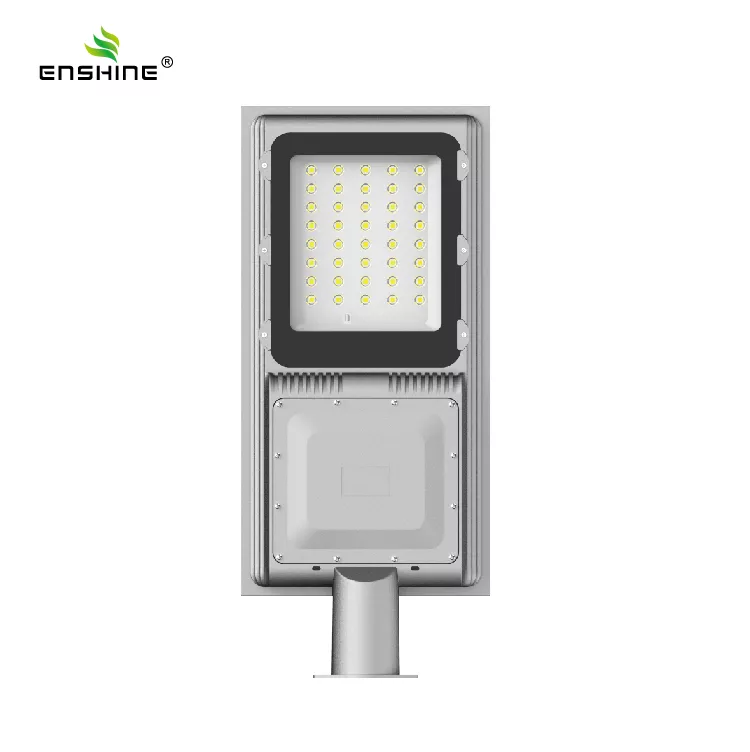
The daily cycle is straightforward, and understanding it explains why a solar street light is specified differently from a mains one. During daylight hours, the solar panel converts solar energy into electric energy to charge the storage battery. The controller manages that charging and protects the battery from overcharge.
When ambient light drops, the controller's light-control function brings the LED on. It then decides how the light behaves for the rest of the night. On a fixture with radar sensing, a microwave radar induction system watches the road: when a vehicle or pedestrian approaches, the light runs at full power, and at other times it drops into power saving mode. In the morning, the panel starts charging again and the cycle repeats.
| Daylight | Panel charges the battery; controller regulates the charge. |
| Dusk | Light-control function switches the LED on. |
| Night | Battery discharges through the LED. Radar or time control varies output between full power and power saving mode. |
| Dawn | LED switches off; charging resumes. |
The consequence for a project buyer is simple: what the light does on a given night depends on what the panel collected that day and what the controller allows the battery to deliver.
The four parts you are really buying
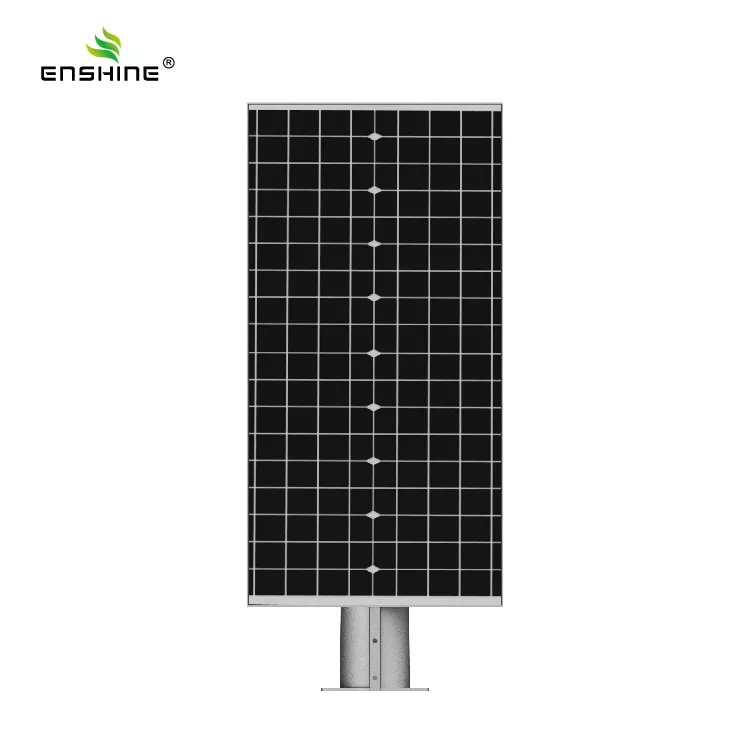
Solar panel
The panel sets the daily energy input. Panel wattage and conversion efficiency decide how quickly the battery recovers after a full night of discharge. A+ grade panels with conversion efficiency above 21.3% are used on the Solar Streetlight with Multi Sensor, where panel wattages are stated per model, such as monocrystalline 5V 18W on the 200W version and 28W on the 300W version. Glass and silicon wafer lamination is used in the all-in-one construction on the All-in-One Solar Street Light from this all in one solar street light manufacturer.
Battery
The battery sets how much energy is available after dark and how many poor-sun days the fixture can ride through. Chemistry and capacity both matter. Lithium iron phosphate (LiFePO4) packs appear in the multi-sensor model, with discharge depth reaching 95% and a stated service lifespan of 6-8 years; the all-in-one series uses a high-performance lithium battery. Capacity is quoted in mAh per model, for example 15000mAh on the 200W multi-sensor version and 25000mAh on the 300W version.
LED light source
The light source determines the quality of illumination on the ground. SMD 3030 patch light sources and high lumen LED chips are used across these models, and the optical design matters as much as the chip. The all-in-one series uses tiltable LED optics that tilt from 5-15 degrees to match local lighting requirements, while the multi-sensor and standard solar LED models use a 70 by 140 degree beam angle. Where a datasheet states a high-transmittance lens, that describes the optical path, not the light output.
Controller
The controller is the decision-maker. It handles charge regulation, light control, and the operating pattern. Working patterns on the YX-SS-01 and YX-SS-02 models are light control plus remote control plus time control. The YX-SL-04-SS all-in-one model uses time control and radar sensing instead. This difference affects how you commission the lights on site, so it is worth checking per model rather than assuming one control scheme across a range.
Reading a datasheet line by line
A solar street light datasheet mixes two kinds of numbers: what the light produces, and what the system can sustain. Reading them separately prevents the most common specification mistake.
| Specification line | What it tells a project buyer |
|---|---|
| Wattage (100W / 200W / 300W, 400W on one model) | The nominal size class of the fixture. Use it to compare models within a range, not as a direct statement of delivered light. |
| Efficacy (120-130 lm/W) | How efficiently the fixture turns stored energy into light. Higher efficacy means less battery drain for the same output. |
| CCT (6000-6500K) | The colour temperature of the light. This is a cool white range common on road and area lighting. |
| CRI (above 70) | How faithfully colours are rendered under the light. Relevant where CCTV or visual identification matters. |
| IP and IK rating (IP65, IK08) | IP65 covers dust and water ingress protection; IK08 covers resistance to mechanical impact. Both are relevant to long-term outdoor exposure. |
| Battery chemistry and capacity | How much energy is stored and how long the pack is expected to last. Capacity must be read together with the working hours required. |
| Working pattern | Whether the light runs on light control, time control, remote control, or radar sensing, and how output varies across the night. |
| Working time (12H on fully charged) | The intended duration of operation after a full charge, under the stated pattern. |
| Warranty (3 years) | The manufacturer's stated coverage period for the fixture. |
Efficacy is the line buyers most often underuse. A fixture with 120-130 lm/W draws less from the battery to produce the same light as a less efficient one, which directly affects how many hours it can run and how it behaves after a run of cloudy days.
Sizing the panel and battery together
Panel and battery capacity cannot be chosen independently, and neither can be chosen without the third input: the working hours you need and the local sun conditions the system will actually see. If a project requires a long night of full-power operation, both the panel and the battery have to support it. Increasing the panel alone does not extend the night; it only shortens the recovery time on a sunny day.
Backup behaviour follows the same logic. The number of backup days depends on battery capacity and the lighting configuration. Most Enshine models can operate for 2-5 consecutive rainy days after a full charge, and higher-capacity models may support longer backup time. If a site has a long rainy season, the honest question to put to a supplier is how many consecutive days of backup are needed and what lighting pattern the lights will run during that period.
Radar sensing and time control change the energy budget. A light that runs at full power only when someone is present draws far less over a night than one held at full output, which is why the working pattern belongs in the same conversation as panel and battery sizing.
When solar is the right choice, and when it is not
Solar street lights are the stronger option when the cost or difficulty of getting power to the site outweighs the cost of the fixture.
- No cable run available. Remote roads, parks, industrial parks, and pedestrian streets often have no convenient grid connection point. A fixture that generates its own power removes the trenching and cabling scope entirely.
- Remote or difficult sites. Where excavation is expensive, disruptive, or simply not permitted, a standalone light avoids the civil work.
- Temporary or staged projects. Where lighting is needed before permanent power is available, or where a site will be lit in phases, solar fixtures can be installed without waiting for the electrical infrastructure.
Mains-powered LED street lights remain the better fit where grid power is already present and reliable, where the lighting load is very high and continuous, or where a fixed and ample power supply makes battery replacement and panel maintenance unnecessary. The application list for these products reflects the first case: urban roads, residential roads, industrial parks, landscape lighting, parks, pedestrian streets, and fitness and leisure squares.
For a side-by-side look at how fixture architectures differ across these sites, the existing comparison of all-in-one versus split solar street lights for remote areas covers that decision directly. Once the definition and architecture are settled, the solar street light buyer's guide takes the next step into project selection.
A note on the models referenced here
The three product families used as examples in this article differ in ways that a project buyer will notice at installation. The all-in-one YX-SL-04-SS series integrates everything in one housing with tiltable optics and IP65/IK08 protection, and is offered in 100W, 200W, and 300W. The multi-sensor YX-SS-01 is available in 200W and 300W and can be installed on a wall, with no lamp arm required. The standard Solar LED Street Light YX-SS-02 runs to 200W and 400W with a die-casting aluminium housing. All three carry a 3-year warranty and a 6000-6500K CCT range.
FAQ
- Do solar street lights work on cloudy or rainy days?
- Yes. The battery stores energy collected during sunny periods and powers the light when sunlight is insufficient. The number of backup days depends on battery capacity and the lighting configuration. Most Enshine models can operate for 2-5 consecutive rainy days after a full charge, and higher-capacity models may support longer backup time.
- What is the difference between time control, light control, and radar sensing?
- Light control switches the light on when ambient light drops. Time control changes output at set hours of the night. Radar sensing uses a microwave radar induction system to run the light at full power when a vehicle or pedestrian approaches, and at a reduced output at other times. The YX-SL-04-SS all-in-one uses time control and radar sensing; the YX-SS-01 and YX-SS-02 use light control, remote control, and time control.
- Can I compare wattage alone between two solar street lights?
- No. Wattage describes the size class, but the usable night performance also depends on efficacy, battery capacity, panel wattage, and the working pattern. Two fixtures with the same wattage can deliver very different run times if their batteries and patterns differ.
- Does a solar street light need a lamp arm?
- Not always. The YX-SS-01 can be installed on a wall, and a lamp arm is not essential. Mounting method should be confirmed against the actual pole or wall arrangement on site.
Next step
If you are specifying solar street lighting for a project, the useful inputs are the required working hours, the number of consecutive poor-sun days the site must ride through, the mounting arrangement, and the control pattern you want. Enshine Lighting is a professional LED lighting manufacturer providing OEM and ODM solutions for global B2B customers, and can discuss those inputs against the all-in-one, multi-sensor, and standard solar LED ranges.